Do AI Citations Actually Matter? What 354,004 AI Answers Show
Sitefire research across 354,004 AI answers on what an AI citation is worth, and why being sourced without being cited pays almost nothing.

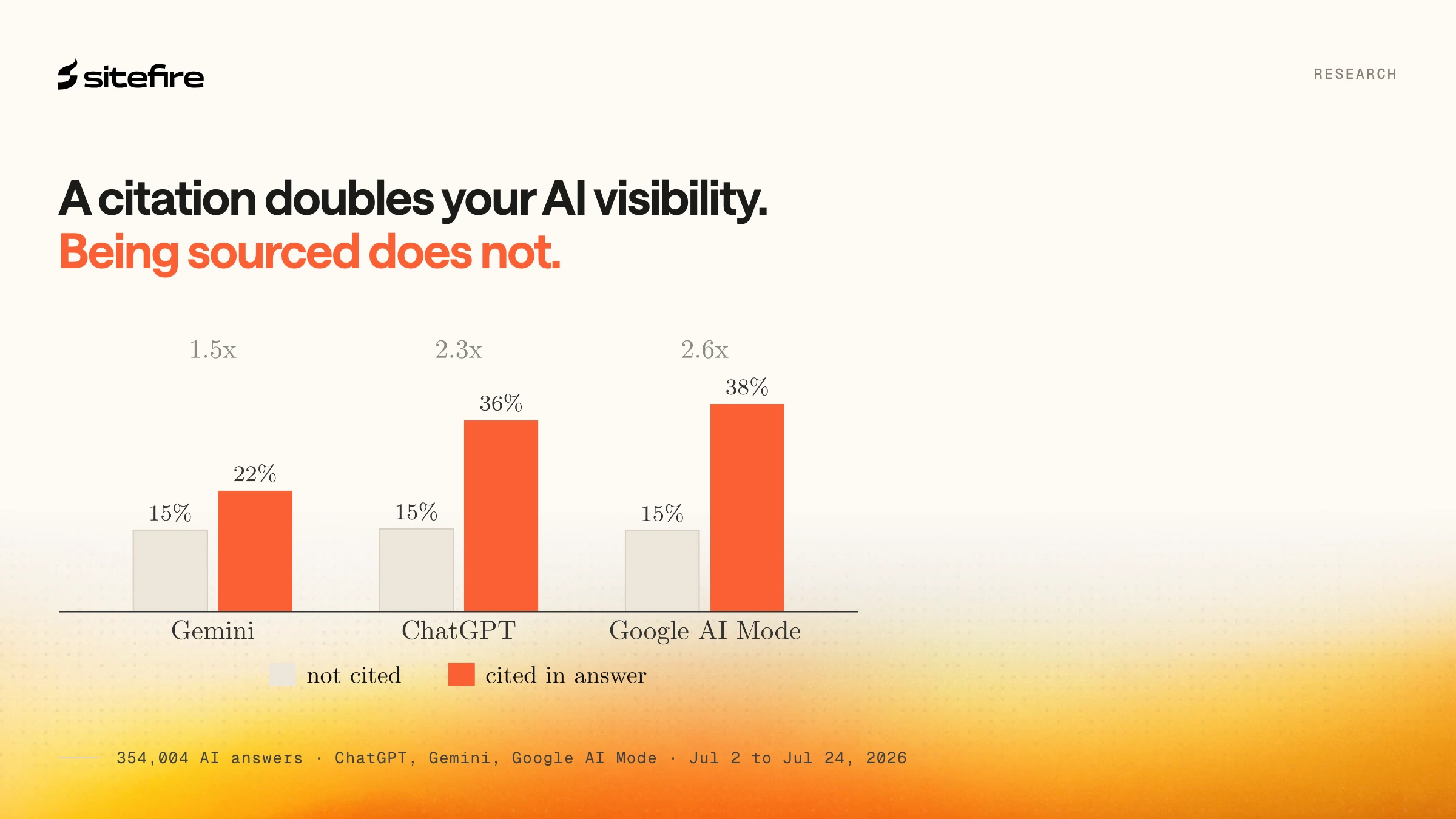
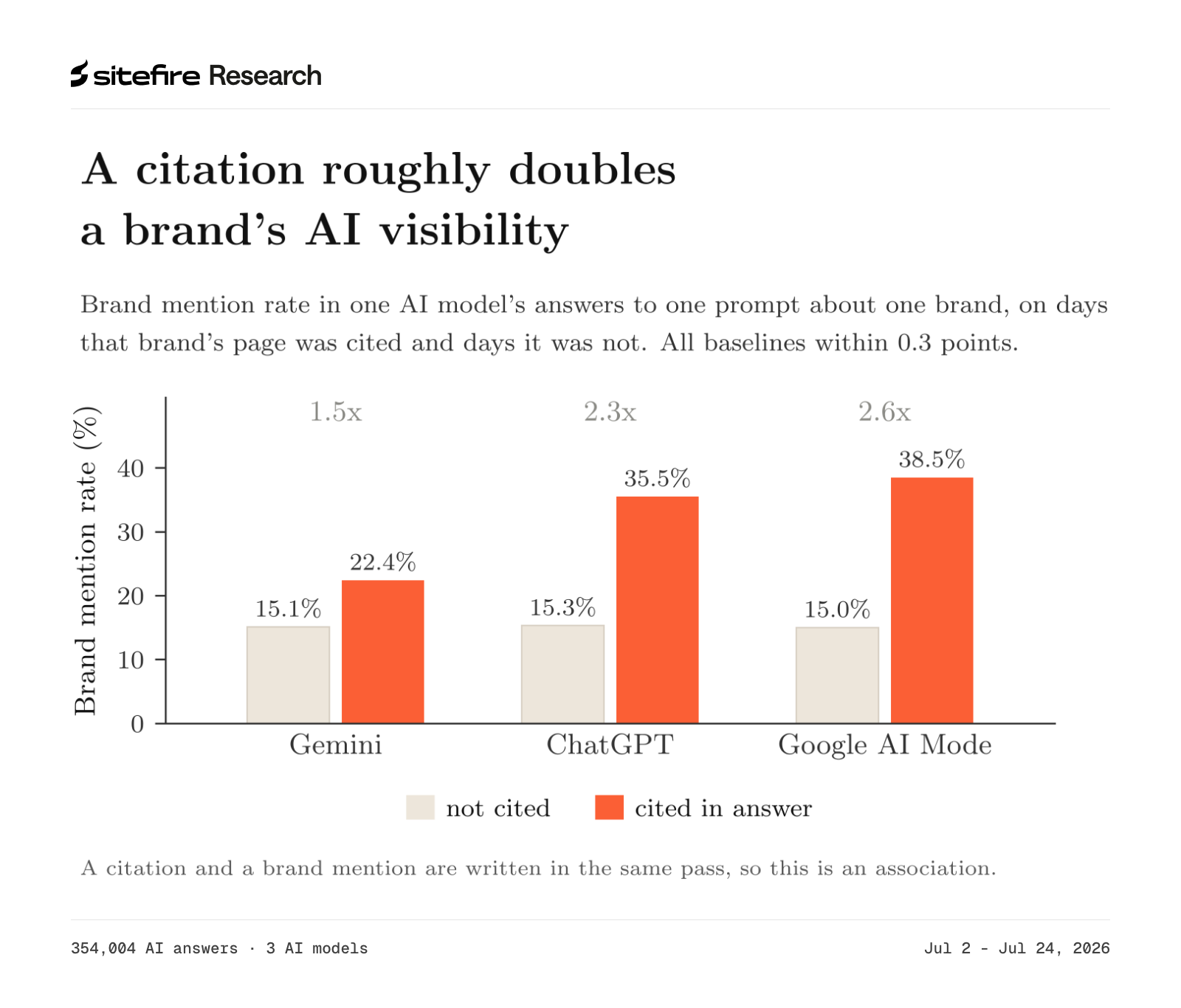
Yes, and by roughly a factor of two. On days an AI model cited a brand's page, that brand appeared in about a third of its answers. On days the same AI model answered the same prompt about the same brand and did not cite that page, about 15%.
Sitefire measured this across 354,004 AI answers from ChatGPT, Gemini and Google AI Mode over three weeks in July. Then we asked the harder version of it: does the value start earlier, when an AI model surfaces your page but does not cite it? It does not. That step is worth almost nothing, and it is the more useful of the two findings.
This matters because most GEO work is still reported as retrieval. Pages surfaced, pages crawled, pages in the index. The number that moves a brand's visibility sits one step further along.
What a citation is actually worth
The comparison is deliberately narrow. Same AI model, same prompt, same brand, on days that brand's page was cited against days it was not. Everything that makes one brand more visible than another stays fixed, because the brand is being compared against itself.
| AI model | not cited | cited | ratio |
|---|---|---|---|
| Gemini | 15.1% | 22.4% | 1.5x |
| ChatGPT | 15.3% | 35.5% | 2.3x |
| Google AI Mode | 15.0% | 38.5% | 2.6x |
| All three | 15.1% | 32.9% | 2.2x |
Two things are worth pausing on. The three baselines land within 0.3 points of each other, which is not something we arranged; it falls out of applying one population rule to all three AI models. And the effect is positive on all three despite them being built by two different companies on different infrastructure.
It also holds at the level a practitioner actually operates at. Across companies with enough data to measure individually, 96% show a positive effect. The middle company sees 2.6x. The bottom tenth still sees 1.2x.
Now the number that gets left out of vendor decks. A 32.9% brand mention rate on cited days means 67% of cited pages arrive with no brand mention at all. That is not a second finding. It is the same finding read from the other end, and it is the reason one citation is not a result. A citation is a real lever with a low hit rate, which makes the rate you get cited at on the prompts you care about the thing worth reporting.
Is the AI model just picking the brand first?
Reverse causation is the main alternative explanation, and the data constrains it: citation matters four times less when the prompt already carries a brand mention.
This is the objection that should occur to anyone reading the table above, and it is a good one. An AI model might settle on recommending a brand and then reach for that brand's page to support what it was already going to say. The citation would follow the decision rather than do any work. Comparing cited days against not-cited days cannot tell those apart on its own.
We split the comparison by whether the prompt itself already carried a brand mention. Where it did, so the AI model had every reason to name that brand regardless, citation moves the outcome by 4.0 points. Where the prompt did not, it moves it by 18.0 points.
If the pattern were mostly an AI model deciding first, those two numbers would look alike. They do not, by a factor of four and a half.
There is a limit to how far this goes, and it is structural rather than something a better design fixes. Retrieval and generation happen in a single forward pass, so a citation and a brand mention are produced together rather than one arriving before the other. Everything here is an association measured under tight conditions, not the result of changing one thing and watching another move.
Does being sourced pay on its own?
Being sourced is when an AI model's own search surfaces a page. On its own it is worth almost nothing: 12.6% against 11.2% for pages never sourced.
Here is where the intuition most GEO teams operate on turns out to be wrong.
If a citation is worth a doubling, the natural assumption is that the steps leading up to one are worth something too. Get crawled, get into the AI model's research, and you are part of the way there. It is a comfortable assumption because retrieval is the part of the funnel that is easiest to measure and easiest to influence.
On ChatGPT we can test it directly, because that is where the AI model's own fan-out query is recorded. Sitefire records the pages an AI model surfaces as well as the ones it cites, which is what makes the middle state observable at all.
That splits a brand's page into three states rather than two on any given prompt: never sourced, sourced but not cited in the answer, or cited. Holding the fan-out query fixed, so the comparison runs across answers researching the same thing, gives this.
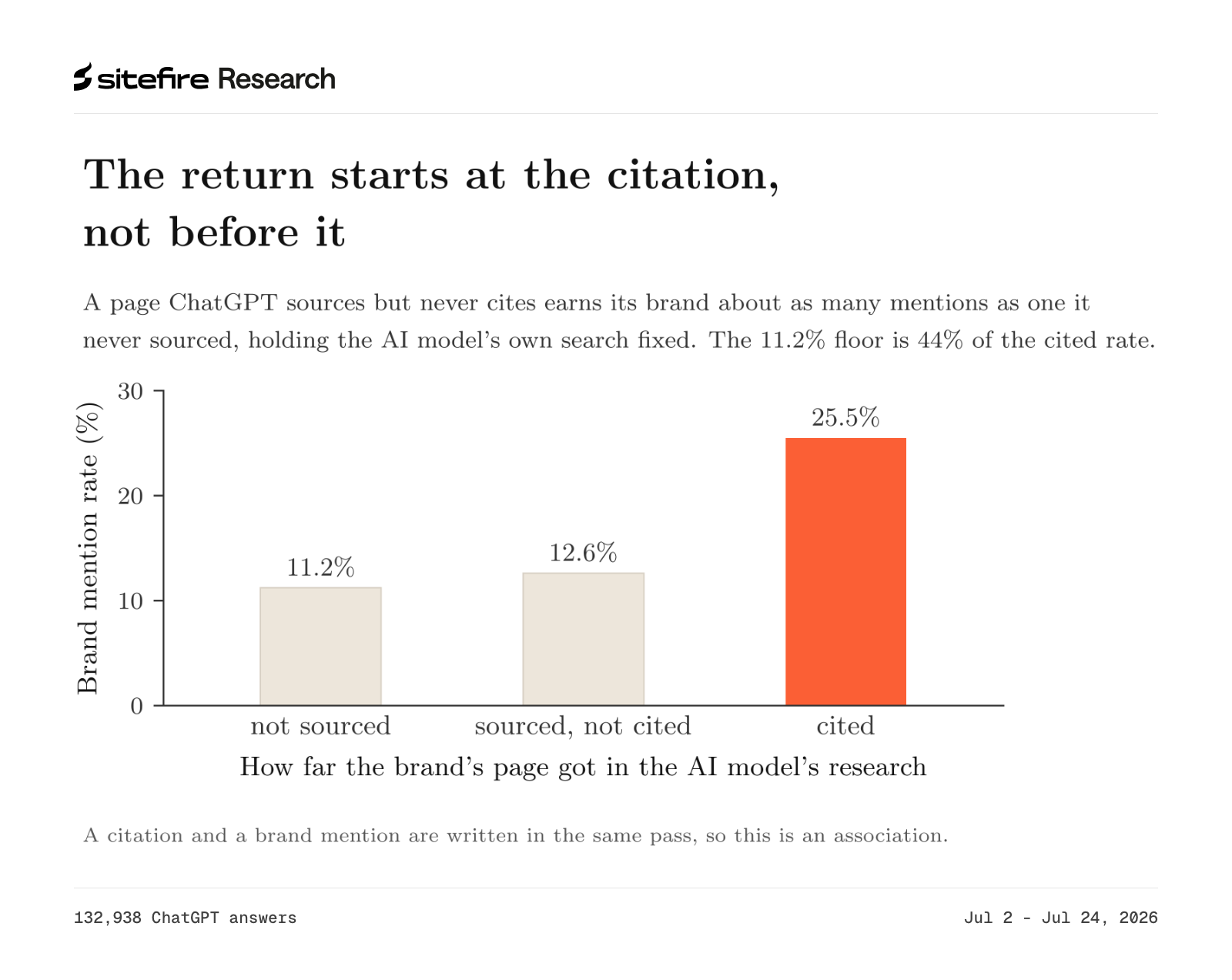
| How far the page got | brand mention rate |
|---|---|
| not sourced | 11.2% |
| sourced, not cited | 12.6% |
| cited | 25.5% |
A page ChatGPT surfaced and then passed over earns its brand about as many mentions as a page it never surfaced at all. The step from not sourced to sourced is 1.4 points. Run the identical comparison against the following day's exposure, where no real effect can exist, and it returns 0.2 points. The step from sourced to cited is 12.9.
Being surfaced is not a partial win on the way to a citation. The return starts at the citation.
The floor is part of the answer
The other number in that table deserves as much attention as the doubling. In answers where a brand's page was never sourced at all, that brand is still mentioned 11.2% of the time. That is 44% of what the cited state delivers.
That floor is knowledge the AI model already carries about the brand, plus third-party pages it surfaced instead of the brand's own. It is the part of AI visibility that exists whether or not a page gets cited on the day. It is also why Sitefire reports brand mention rate rather than citation counts: the two move together, but only one of them is the outcome.
Anyone forecasting off the doubling without subtracting the floor will overestimate what a citation buys them. The honest framing is that a citation roughly doubles a rate that does not start at zero.
Who does a citation pay most for?
Brands an AI model rarely mentions otherwise. For them the cited state shows 9.2x the brand mention rate, against 1.1x for already-visible brands.
Not everyone equally, and the pattern is the useful part. We grouped brands by how visible they already were on a prompt, measuring that on separate days from the effect so that the grouping and the outcome share no observations.
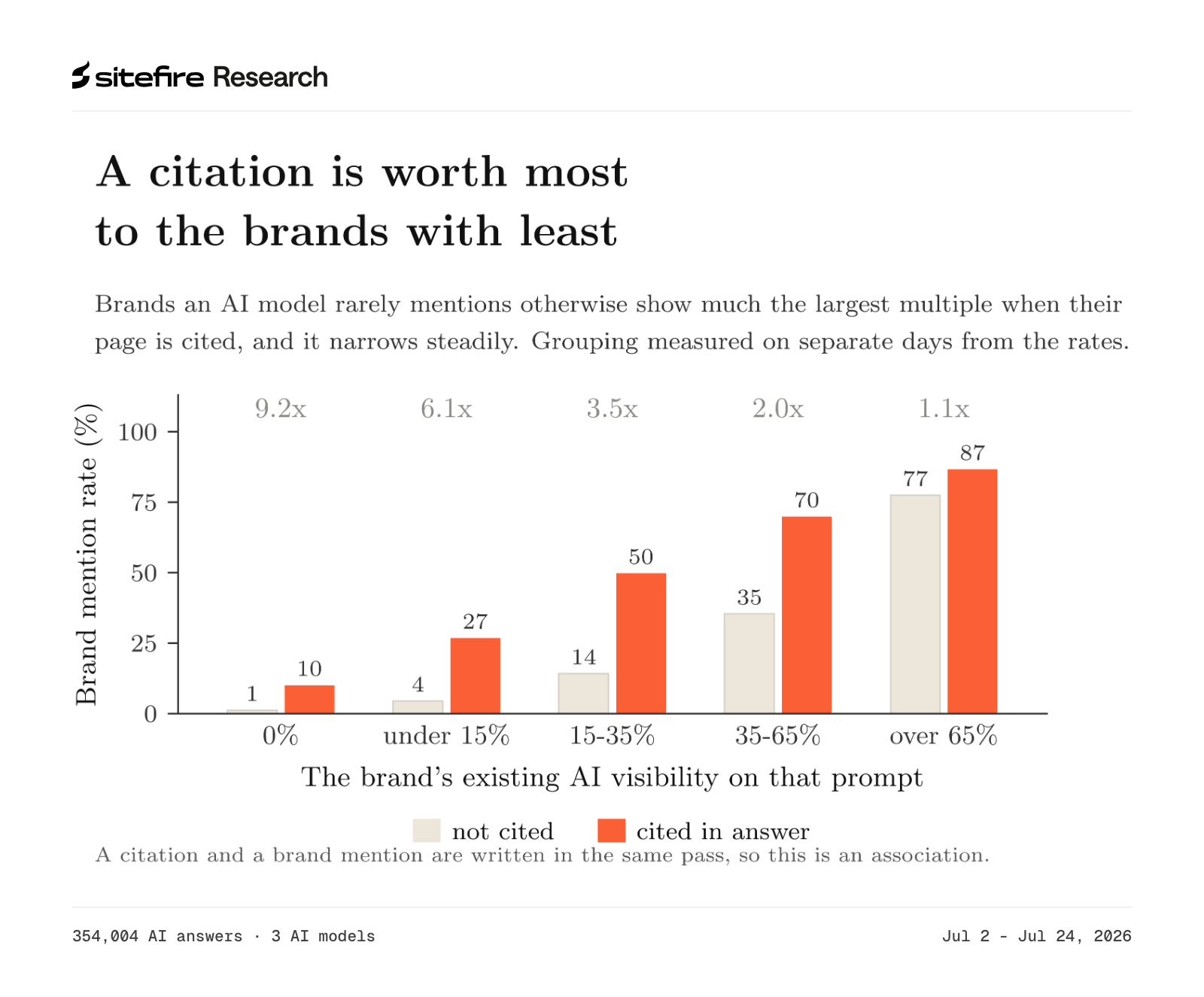
| Existing AI visibility | not cited | cited | multiple |
|---|---|---|---|
| 0% | 1.1% | 10.0% | 9.2x |
| under 15% | 4.4% | 26.7% | 6.1x |
| 15-35% | 14.1% | 49.7% | 3.5x |
| 35-65% | 35.3% | 69.8% | 2.0x |
| over 65% | 77.4% | 86.6% | 1.1x |
The multiple narrows monotonically as a brand becomes more visible, and it does not disappear at any level. Even brands an AI model already mentions in most answers still show a positive one, just a small one.
The practical read is that the leverage sits where the current numbers look worst. On the prompts where an AI model already mentions you in most answers, a citation is worth having and will not change much. On the prompts where it almost never mentions you, it is worth several times more.
Where this holds, and where it does not
Research is only useful if you know its limits.
This is an association, not an experiment. Retrieval and generation happen in one pass, so a citation and a brand mention are written together. Nothing here says what would happen if you changed one and left everything else alone. The branded-prompt split above is what constrains the alternative explanation; it does not eliminate it.
The three-state result is ChatGPT. ChatGPT is where the AI model's own fan-out query is recorded, which is what makes the middle rung visible at all. The two-state result covers all three AI models.
These are commercial buying-intent prompts. They describe what happens when someone is actively shopping, not AI usage in general.
Ratios are firmer than levels. The interval around the citation step is wide, and that width is part of the result rather than a detail. Any forecast built on these numbers should use the range, not the point.
We cannot tell you what third-party coverage is worth to you. A cited page is never joined to the brands its text mentions, so whether being covered on a forum, a publisher or a comparison site helps your brand specifically is out of reach in this data. Not unmeasured, out of reach.
What to do differently
Three moves, each tied to a number above.
- Stop counting retrieval as progress. A page surfaced and passed over performs like a page never surfaced at all. If your GEO reporting leads with pages crawled or pages in the AI model's research, it is reporting the step that does not move the outcome.
- Report citation rate on the prompts you care about, not citations in total. Two thirds of cited pages arrive with no brand mention, so a count of citations tells you very little. The rate at which you get cited on a specific prompt tells you a lot.
- Aim first at the prompts where the AI models rarely mention you. That is where a citation is worth 9.2x rather than 1.1x. It is also, in most teams' reporting, the part of the prompt set that gets ignored because the current numbers look bad.
Sitefire built our earlier research on why AI models cite different sources on the same measurement panel, and it pairs with this one: that post covers which pages get cited, this one covers what a citation is worth once you have it.
Frequently asked questions
Do AI citations increase brand mentions?
On days an AI model cited a brand's page, that brand was mentioned in 32.9% of answers, against 15.1% on days it did not, comparing the same AI model on the same prompt about the same brand. That is an association measured under tight conditions rather than a causal result, because retrieval and generation happen in a single pass.
Does getting crawled or retrieved by ChatGPT help?
Not on its own. A page ChatGPT sourced but did not cite earns its brand about as many mentions as a page it never sourced, 12.6% against 11.2%. The measurable return begins at the citation.
Which AI model rewards citations most?
Google AI Mode showed the largest multiple at 2.6x, ChatGPT 2.3x and Gemini 1.5x. All three started from almost the same baseline, within 0.3 points of each other.
If I am invisible in AI answers, is GEO worth it?
That is where the multiple is largest. For brands an AI model rarely mentioned otherwise, the cited state showed 9.2x the brand mention rate of the not-cited state, against 1.1x for brands already mentioned in most answers.
Does one citation fix a prompt?
No. 67% of cited pages arrive with no brand mention at all. A citation is a lever with a low hit rate, which is why the rate matters more than any single instance.
Key takeaways
- A citation is worth roughly a doubling of a brand's AI visibility: 15.1% to 32.9%, positive on all three AI models and for 96% of companies measured.
- Being sourced without being cited is worth almost nothing. That step moves the brand mention rate 1.4 points, against 0.2 for a placebo.
- The floor matters. Brands are mentioned 11.2% of the time with no page sourced at all, which is 44% of the cited-state rate.
- Two thirds of cited pages carry no brand mention, so citation rate on specific prompts beats citation counts.
- The multiple is largest where a brand is currently least visible, 9.2x against 1.1x.
Methodology
Two Sitefire studies on one measurement panel, frozen before analysis.
The first covers 354,004 answers from ChatGPT, Gemini and Google AI Mode between 2 and 24 July 2026. The unit is a single AI model, prompt and brand, observed across the window. Within each unit we compare the brand mention rate on days that brand's page was cited against days it was not, then average across units with no weighting. A unit contributes only if both conditions occur, which is what makes the comparison a within-brand one.
The second covers the 132,938 ChatGPT answers inside that same window. ChatGPT is where the AI model's own fan-out query is recorded, which is what makes the middle state visible. Holding that query fixed, a page is classified as not sourced, sourced but not cited, or cited, and the three rates are computed on the same set of prompt and brand pairs so the levels chain.
The two studies report the doubling from different starting points, and the difference is a population difference rather than a disagreement. The first compares cited against not cited across all three AI models and reports 15.1% to 32.9%. The second compares cited against sourced-but-not-cited on ChatGPT with the fan-out query held fixed, and reports 12.6% to 25.5%. Both land near a factor of two.
A brand mention is the brand's name appearing in what the answer says. Where an AI model renders a citation using the site's domain as the visible link text, that occurrence is excluded, since otherwise the citation and the mention would be produced by the same characters and the comparison would measure nothing.
Intervals are computed by resampling whole companies rather than individual observations, because observations within one company are not independent. We publish the answer count and the AI models; other counts stay internal.
Sources
Sitefire proprietary analysis. 354,004 AI answers across ChatGPT, Gemini and Google AI Mode, 2 to 24 July 2026, including 132,938 ChatGPT answers for the three-state analysis.