Query Fan-Out: What AI Search Actually Does With Your Query
AI search rewrites every query into 5-20 separate searches before answering. Learn how query fan-out works and why 68% of AI-cited pages aren't in the top 10.

There's a heated debate in the search industry right now. One side says GEO is the future and SEO is dead. The other says GEO is just a rebrand of what SEO people have been doing for years. Both sides are wrong, and both are right.
There's a debate in the search industry right now. One side says GEO is the future and SEO is dead. The other says GEO is just a rebrand of what SEO people have been doing for years. Both sides are wrong, and both are right.
I don't care about the label. What I care about is understanding what the machine actually does when someone types a question into ChatGPT, Google AI Mode, or Perplexity. Because once you see the mechanism, the debate resolves itself.
The mechanism is called query fan-out. It is the single most important concept for understanding how AI search differs from traditional search. And yet most articles about GEO either skip over it or explain it at surface level.
Here's what actually happens, step by step, when an AI search engine processes your query.
How Traditional Search Works
This part is easy. A user types a query, say "best CRM for small business." Google runs that query against its index, ranks the results, and returns ten blue links. One query in, one ranked list out.
Your job as an SEO is to rank on that list. You optimize a page for that keyword, build authority, earn backlinks, and work your way up. The unit of competition is clear: one keyword, one ranking - a model that has worked for 25 years.
A single search step in AI search still works exactly this way. What changed is what happens before and after.
What Is Query Fan-Out?
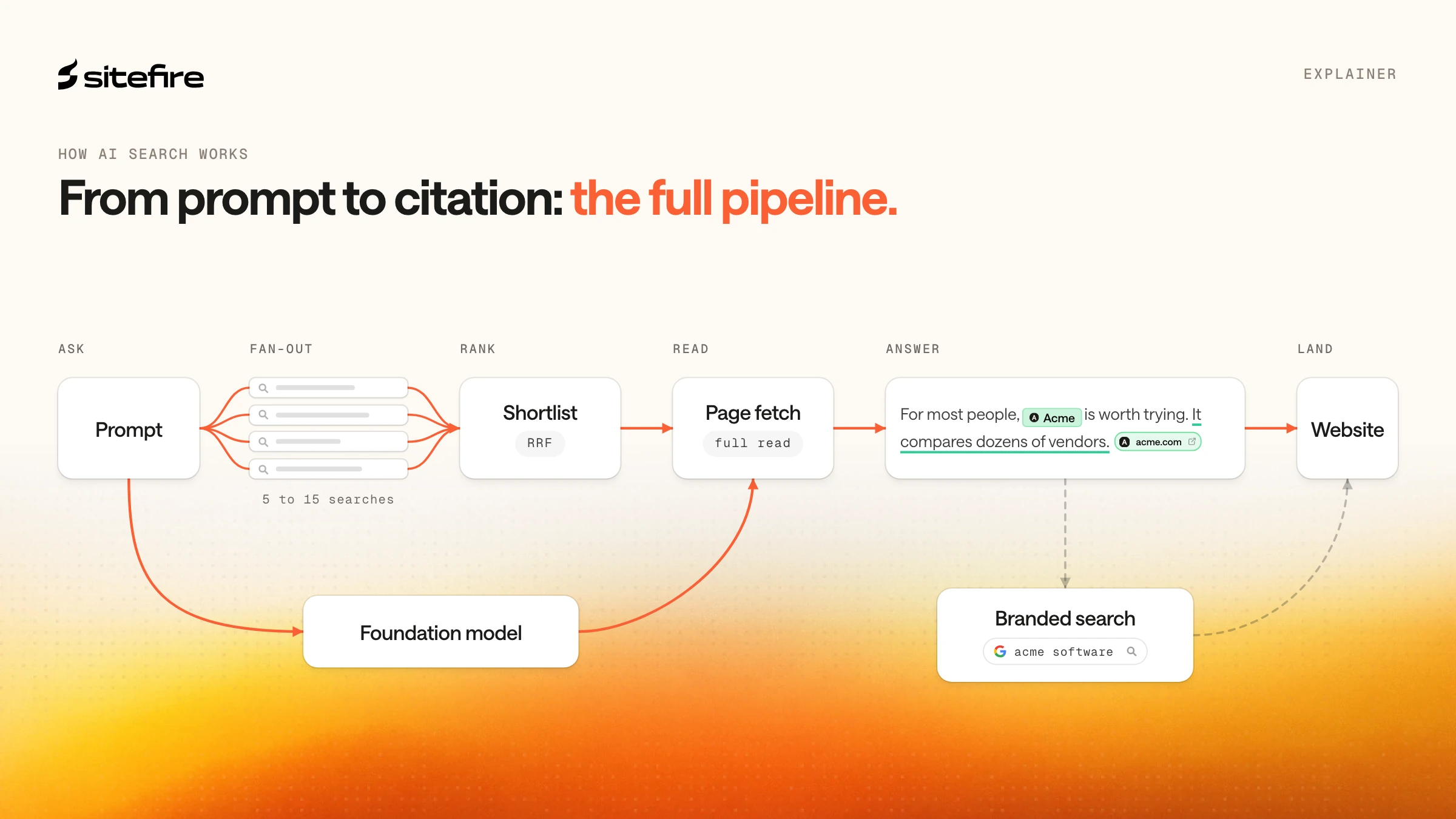
Query fan-out is the process where AI search engines decompose a single user query into multiple separate searches, run each one independently, then merge the results into one synthesized answer.
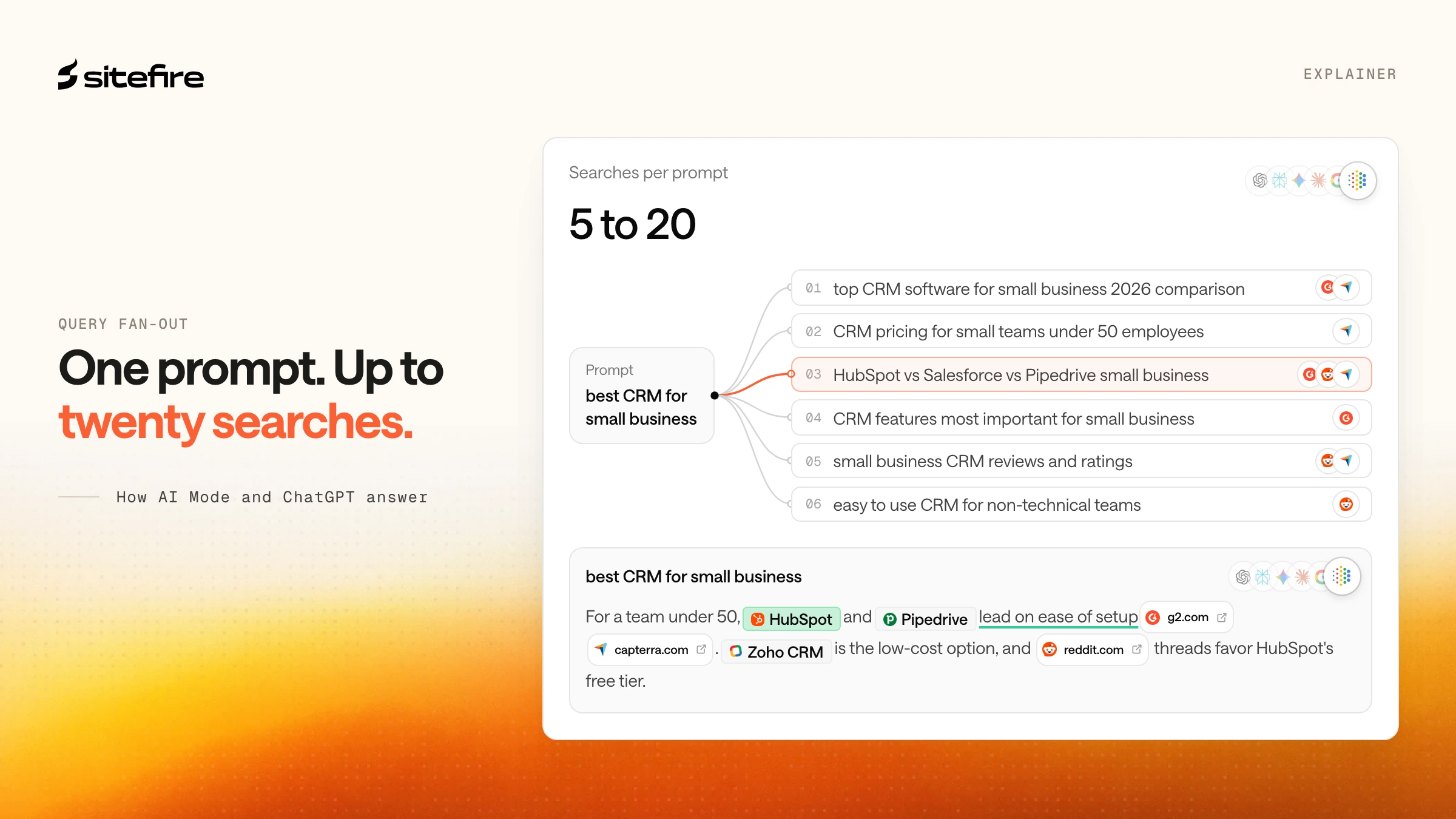
When a user types "best CRM for small business" into Google AI Mode or ChatGPT, the AI doesn't run one search. It rewrites the query into 5 to 20 separate searches. Something like:
-
"top CRM software for small business 2026 comparison"
-
"CRM pricing for small teams under 50 employees"
-
"HubSpot vs Salesforce vs Pipedrive small business"
-
"CRM features most important for small business"
-
"small business CRM reviews and ratings"
-
"easy to use CRM for non-technical teams"
-
"CRM with best free tier for startups"
Each sub-query is searched independently against the web index. The results are merged, and the AI synthesizes one comprehensive answer from the combined results.
One query in, many searches out. That's query fan-out.
- 01top CRM software for small business 2026 comparison
- 02CRM pricing for small teams under 50 employees
- 03HubSpot vs Salesforce vs Pipedrive small business
- 04CRM features most important for small business
- 05small business CRM reviews and ratings
- 06easy to use CRM for non-technical teams
For a team under 50,  HubSpot and
  Pipedrive lead on ease of setup
 g2.com
 capterra.com.
  Zoho CRM is the low-cost option, and
  reddit.com threads favor HubSpot's free tier.

The numbers vary by platform and query complexity. In Sitefire's analysis of 1.47 million AI answers, we see 4 to 10 searches per prompt: less for ChatGPT, more for Google Gemini and Perplexity. We call this the first stage of the AI citation pipeline. Those searches determine which pages even have a chance of being cited. If your content doesn't match what the AI searches for, you're invisible before the ranking even starts.
Where Do These Searches Come From?
These searches are generated through systematic intent expansion, where the AI identifies related topics, adjacent intents, and predictable modifiers like "comparison," "best," and "reviews."
If you've ever looked at Google's People Also Ask boxes, you already have a good intuition for what's happening. The AI identifies related intents, adjacent topics, and natural follow-up questions, much like PAA does today. Sitefire's prompt analysis across all major AI models confirms this: the searches map closely to the People Also Ask clusters Google already surfaces.
On top of that, AI models insert predictable modifiers: "comparison," "best," "reviews," "2026," "vs." You can see this happening in ChatGPT's thinking panels when it searches the web. It's not mysterious. It's systematic intent expansion.
The academic foundation is a framework called "Rewrite-Retrieve-Read," introduced by researchers at Microsoft Research and Shanghai Jiao Tong University in 2023. Their core insight: there's a gap between what users type and what needs to be searched. The user asks a natural language question. The search engine needs specific, well-formed queries. The AI model bridges that gap by rewriting before searching.
Google has invested heavily in this direction. Patent US12158907B1, granted in December 2024, describes a "Thematic Search" system that identifies themes from search results and generates refined searches for each theme. It's not purely parallel. It can go multiple levels deep: themes break into sub-themes, which break into sub-sub-themes. This is architecturally central to how Google AI Mode works.
Here's the critical detail: only 27% of the searches the model runs remain stable when the same prompt is repeated ( Similarweb). Run the same query twice, and the AI runs largely different searches each time. There is no single fixed set of queries to optimize for. The system is inherently dynamic.
How Are the Results Merged?
Reciprocal Rank Fusion (RRF) is the algorithm that combines ranked lists from multiple searches into a single merged ranking. It scores pages higher when they appear across multiple result lists.
Each sub-query produces its own set of ranked results. But the AI needs to combine all of these into a single pool of sources before synthesizing an answer. This is the part most articles skip.
The standard technique is RRF. Originally published by Cormack et al. in 2009, it's now the industry standard for hybrid search. Microsoft Azure AI Search documents RRF as its merging algorithm. ChatGPT searches via Bing, which is an Azure product. The connection is direct.
In plain terms: if your page shows up in 5 out of 12 sub-query results, it scores dramatically higher than a page that appears in only 1. A CommonCrawl analysis of 3,000 ChatGPT citations found over 120 co-citation relationships - pages that consistently appear together across sub-query results. This is RRF in action. Topical breadth creates compounding visibility.
After rank fusion, the AI doesn't read full pages. It extracts content chunks, self-contained passages typically 130 to 170 words, that directly answer specific aspects of the query. Lists, tables, clear paragraphs with concrete data. Those chunks become the raw material for the synthesized answer.
This is what Sitefire measures when we analyze the citation funnel: from query fan-out to sourced pages to cited pages to brand mentions. Each stage has a drop-off. Understanding RRF explains why pages with broad topical coverage survive the merge step while single-keyword pages don't.
What Actually Changed?
The difference between traditional search and AI search is not the search itself. It is the surface area of queries your content competes on.
Let's be honest. The search step in AI search is still search. The same web index. The same ranking signals: domain authority, relevance, freshness, backlinks. The retrieval doesn't use some exotic new algorithm. It uses the web search infrastructure that already exists.
What's different is what happens before and after:
-
Before: The AI rewrites one query into 5 to 20 separate searches. Each one has its own set of competing pages.
-
After: Results from all those searches are merged via rank fusion and synthesized into one answer. The user never sees a list of links. They see an answer with citations.
| Dimension | Traditional Search | AI Search (Fan-Out) |
|---|---|---|
| Queries executed | 1 per user input | 5-20 searches per prompt |
| Results format | 10 blue links | 1 synthesized answer with citations |
| Merging method | None | Reciprocal Rank Fusion |
| Unit of competition | 1 keyword, 1 SERP | Full cluster of searches |
| Unit of retrieval | Full page | Content chunk (130-170 words) |
| User behavior | Click and evaluate | Read answer (92-94% zero-click) |
| Ranking signals | DA, relevance, freshness, backlinks | Same signals, wider surface area |
The zero-click rate in AI Mode is 92 to 94% ( Ekamoira). Users get their answer without visiting a website. Brand visibility in the AI response is the new visibility.
That table tells the whole story. The ranking signals are familiar. The web index is the same. What changed is the surface area. Instead of competing on one keyword per user intent, you're now competing on 5 to 20 separate searches, most of which you've never explicitly optimized for.
Why the Data Backs This Up
If query fan-out didn't matter, you'd expect the same pages to win in both traditional search and AI search. They don't.
A Surfer SEO analysis of 173,902 URLs across 10,000 keywords found that 68% of pages cited in AI Overviews were not in the top 10 organic search results. Similarweb reports that 25% of URLs cited by ChatGPT had zero organic Google visibility. Only 12% of URLs cited by AI models rank in Google's top 10 for the head term.
Why? Because those pages rank for the fan-out searches, not the head term. A page about "CRM pricing comparison for teams under 50" might never rank for "best CRM for small business" in traditional search. But when AI Mode runs that as one of its searches, the page gets retrieved, merged into the citation pool via RRF, and ends up in the synthesized answer.
Pages that cover the fan-out query space are 161% more likely to earn AI citations than those ranking only for the head term ( Ekamoira). The Spearman correlation between fan-out coverage and AI Overview citations is 0.77, strong, and much higher than the correlation between traditional rankings and AI citations.
Meanwhile, 88% of AI citation opportunities are missed by traditional SEO-only strategies ( Ekamoira). Sitefire's tracking data confirms this pattern: brands that monitor only their head-term rankings are blind to the sub-query surface where most AI citations actually happen.
The Bottom Line
GEO is not replacing SEO. It's not a separate discipline. It's what happens when search engines add a query rewriting step before doing the same search they've always done.
The ranking signals are familiar: authority, relevance, freshness. The web index is the same. What changed is the surface area. Call it GEO, call it SEO. The key mechanism is query fan-out.
And the interesting question is whether your content is visible across the full set of queries AI generates from a single prompt, not just the one the user typed.
Now you know what the machine does. In the next part, we'll cover what to do about it.
Frequently Asked Questions
How many searches does an AI model run per prompt?
Typically 5 to 20 for standard queries, depending on the platform and complexity. Google AI Mode can generate hundreds via Deep Search. Healthcare and e-commerce queries tend to trigger more searches (22 to 28) than general informational queries (8 to 12). The exact number varies with every search.
Can I see which searches ChatGPT runs?
Yes. Open your browser's DevTools, go to the Network tab, and search for your chat ID in the response payloads. Look for search_model_queries to see the exact searches ChatGPT ran. This is the most direct way to observe query fan-out in action.
Does traditional SEO ranking still matter for AI visibility?
Yes. The search step in AI search uses the same web index and ranking signals as traditional search. Pages with strong domain authority, fresh content, and relevant backlinks still perform better in sub-query results. But ranking for one head term is no longer sufficient. Your content needs to appear across multiple sub-query results to score well in rank fusion.
Is query fan-out the same across all AI search engines?
No. ChatGPT sends its searches to Bing. Google AI Mode uses Google's own index. Perplexity maintains its own 200B+ URL index. Each platform runs different searches and applies different merging logic. A page cited by ChatGPT may be invisible to Perplexity, and vice versa. Sitefire tracks AI visibility across all major models for this reason.
What content format works best for AI citation?
AI systems extract content chunks of 130 to 170 words. Self-contained passages with clear headings, data tables, and specific facts are preferred. Pages with statistics are up to 41% more likely to be cited ( Aggarwal et al., GEO: Generative Engine Optimization). Structure and specificity matter more than length.
Key Takeaways
-
Query fan-out is the core mechanism of AI search: one user query becomes 5 to 20 independent searches before any results are returned.
-
The search step in AI search uses the same web index and ranking signals as traditional search. What changed is the surface area.
-
Reciprocal Rank Fusion (RRF) merges results from all of those searches. Pages appearing across multiple result lists score exponentially higher.
-
68% of AI-cited pages are not in the top 10 organic results, because they rank for the fan-out searches, not the head term.
-
Only 27% of the searches the model runs are stable when a prompt is repeated. Broad topical coverage beats single-keyword optimization.
-
Pages covering the fan-out query space are 161% more likely to earn AI citations than those targeting only the head term.
-
GEO is not replacing SEO. It is SEO applied to a wider set of queries that AI generates from a single prompt.
Sources
-
Similarweb. "Query Fan-Out in AI Search." 2025.
-
Similarweb. "GEO Keyword Research." 2026.
-
Ma et al. "Query Rewriting for Retrieval-Augmented Large Language Models." arXiv:2305.14283. 2023.
-
Google. Patent US12158907B1, "Thematic Search." 2024.
-
Google. "AI in Search: Going beyond information to intelligence." 2025.
-
Cormack, Clarke & Buettcher. "Reciprocal Rank Fusion outperforms Condorcet and individual Rank Learning Methods." SIGIR 2009.
-
Microsoft Azure AI Search. "Hybrid Search Scoring (RRF)."
-
CommonCrawl. "How SEOs Are Using Web Graph Data for AI Ranking Signals." 2025.
-
Surfer SEO. "Query Fan-Out Impact Study." 2025.
-
Ekamoira. "Original Research on Query Fan-Out." 2026.
-
OpenAI. "ChatGPT search." Help Center.
-
Aggarwal et al. "GEO: Generative Engine Optimization." KDD 2024.