Trustpilot's AI Search Earnings: The First Proof That AI Visibility Drives Revenue
Trustpilot's AI search click-throughs grew 1,490% YoY and the stock surged 25%. What the first AI search earnings report reveals about brand visibility.

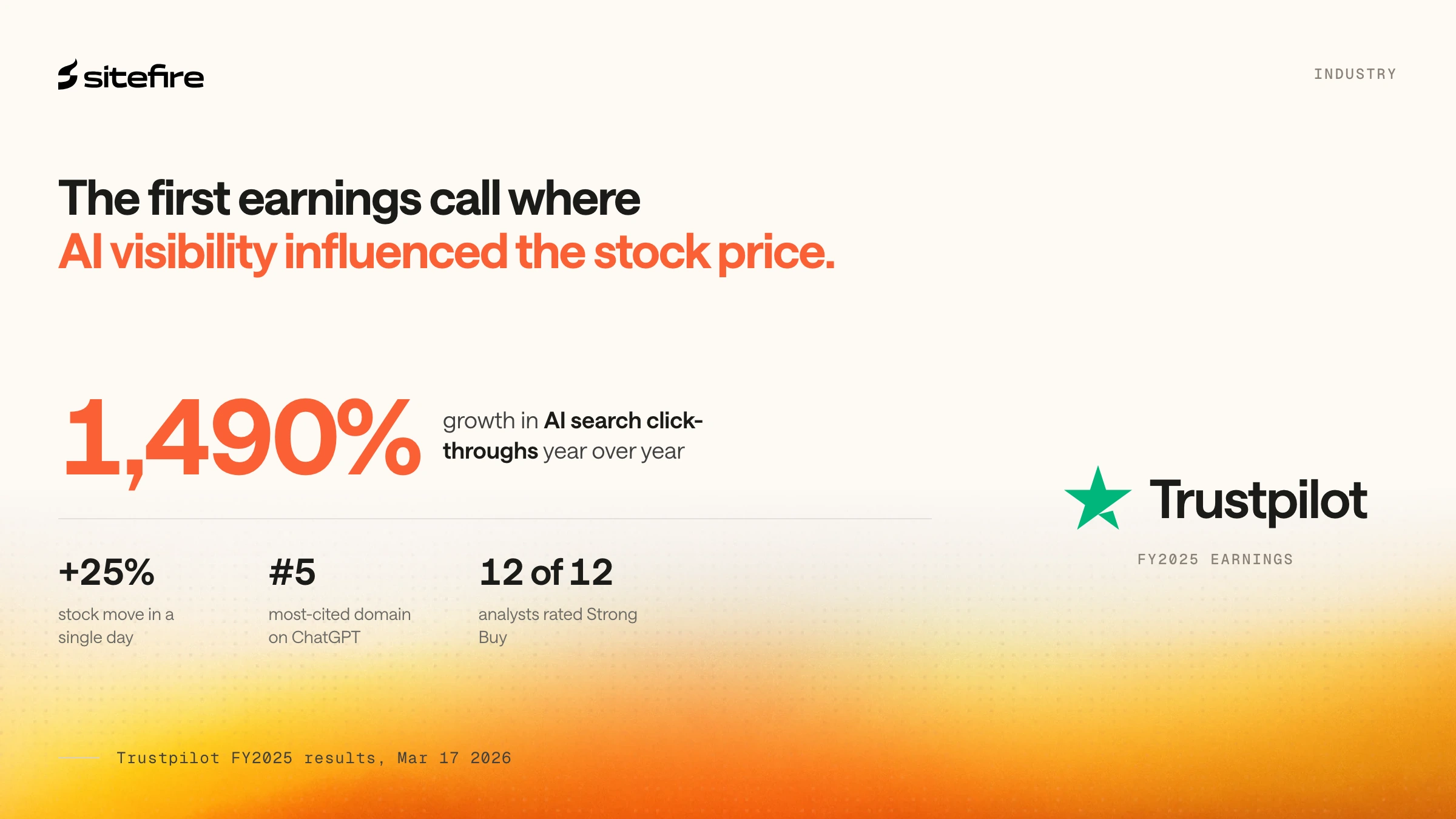
Trustpilot's stock surged 25% in a single day - not because of a product launch or an acquisition, but because of an earnings report that mentioned AI search citations.
On March 17, 2026, CEO Adrian Hennig disclosed that AI search click-throughs to Trustpilot had grown 1,490% year-over-year. Trustpilot was ranked the 5th most-cited domain on ChatGPT globally. All 12 covering analysts rated it a unanimous Strong Buy.
This is the first time AI search visibility appeared as a material factor in a public-company earnings report and moved the stock price. It raises a question every marketing leader should be asking: if investors are now pricing in AI visibility, what should brands be doing about it?
How Big Is AI Search Traffic Today?
AI search is a small but fast-growing channel with outsized conversion impact. According to Conductor's 2026 AEO/GEO Benchmarks report, AI referral traffic represents 1.08% of all web traffic across 13,770 domains and 3.3 billion sessions. ChatGPT drives 87.4% of that traffic.
Those numbers sound small. But the conversion story changes the math entirely.
AI referral traffic converts at 4.4 to 5x the rate of traditional organic search. Semrush reports AI referral traffic converts at 14.2% compared to Google's 2.8%. Conductor found that visitors from AI models convert at 2x the rate in one-third the session time. Exposure Ninja documented a case study showing a 127% increase in orders from AI-driven sessions.
| Metric | Value | Source |
|---|---|---|
| AI referral as % of total web traffic | 1.08% | Conductor 2026 |
| AI referral traffic growth rate | ~1% month-over-month | Conductor 2026 |
| ChatGPT share of AI referral traffic | 87.4% | Conductor 2026 |
| AI referral traffic conversion rate | 14.2% | Semrush |
| Google organic conversion rate | 2.8% | Semrush |
| AI referral traffic conversion premium | 4.4-5x vs organic search | Semrush, Conductor |
Why does AI referral traffic convert better? Because users arriving from AI recommendations have already been pre-qualified. The AI model filtered options, evaluated fit, and recommended the brand before the user ever clicked. By the time they arrive on your site, they are not browsing. They are acting on a recommendation.
In practical terms, 1% of traffic delivers roughly 4-5% of conversion value. And the growth rate is compounding at about 1% month-over-month. The trajectory matters more than today's snapshot.
What Did Trustpilot's Earnings Reveal?
Trustpilot reported FY2025 results on March 17, 2026, beating analyst expectations across every metric. Revenue grew 24% to $261 million. Pre-tax profit nearly tripled, rising 172% to $14.1 million. Adjusted EBITDA reached $40.7 million at a 15.6% margin, up from $24.1 million at 11.4%. Adjusted free cash flow grew 173% to $46.6 million.
The AI narrative dominated the earnings call. Three disclosures stood out.
1,490% AI click-through growth. CEO Adrian Hennig cited "a dramatic rise in the visibility of Trustpilot in AI models" during the earnings call. Trustpilot's sales teams have shifted their pitch entirely. They now lead with AEO (Answer Engine Optimization) positioning in customer conversations rather than traditional reputation management. AEO webinar attendance was reportedly 10x higher than prior events.
5th most-cited domain on ChatGPT globally. According to AI citation tracking data cited in the earnings call, Trustpilot ranked 5th globally in January 2026. The CEO referenced this ranking directly in the investor presentation. AI search visibility has entered the language of quarterly earnings.
62 million reviews in 2025 alone. That is more than Trustpilot received in its first 12 years combined (2007-2019). Total platform reviews surpassed 300 million. High-value customers paying $20,000 or more per year grew 35%, with net dollar retention of 111% in that segment. Cumulative review volume grew 47% in the three years since ChatGPT launched.
Sherwood News called Trustpilot "a rare software sector winner amid AI disruption." The company has set a target of 30% EBITDA margin by 2030, up from 15.6% today.
Why Do Review Platforms Dominate AI Citations?
Review platforms are the second most-cited source type when AI models answer buying-intent queries. They rank behind only product recommendation media and ahead of traditional media, new media, and direct brand sites.
In a study of 36,127 buying-intent queries on ChatGPT, First Page Sage found that consumer review platforms received 5,983 citations. The pattern holds across AI models. According to SE Ranking's analysis of 30,000 commercial keywords, 34.5% of AI Overviews cite at least one review platform. G2 holds 23.1% citation share, Gartner Peer Insights 26.0%, and Capterra 17.8%.
| Source Type | Citations (buying-intent queries) | Rank |
|---|---|---|
| Product recommendation media | 7,642 | #1 |
| Consumer review platforms | 5,983 | #2 |
| Traditional media | 4,581 | #3 |
| New media | 3,826 | #4 |
| Direct brand sites | 2,208 | #5 |
Source: First Page Sage , 36,127 buying-intent queries on ChatGPT
Why do AI models favor review platforms? Because they weight signals that are hard to manufacture at scale. Verified reviews from real customers represent exactly that kind of signal. Unlike blog posts or landing pages, review platform content aggregates independent human judgment. Each review is a data point that reinforces or contradicts a brand's claims.
The Princeton GEO study, published at ACM SIGKDD 2024, tested optimization strategies on a benchmark of 10,000 queries. Adding statistics improved AI visibility by up to 33%. Adding citations and quotations improved it by 28-41%. Review platforms naturally contain both - verified data points and direct customer quotes.
According to Superlines' aggregated analysis of 34,234 AI responses, domains with review platform profiles have a 3x higher chance of being cited by ChatGPT. For AI models, review platforms are reference-grade content. They combine the scale, structure, and authenticity they need to make confident recommendations.
The Trust Paradox: Losing Traffic, Gaining Authority
Here is the paradox. Review platforms are simultaneously the most-cited source type in AI search and the fastest-declining category in organic search.
According to SE Ranking, between January 2024 and December 2025:
-
G2 lost 84.5% of organic traffic (2.56 million to 397,000 monthly visits)
-
Capterra lost 89% of organic traffic
-
TrustRadius lost 92.2% of organic traffic
Yet in the same period, review platforms became the #2 most-cited source type for buying-intent queries in AI answers. The value shifted. It moved from direct traffic (users visiting the review site) to citation authority (AI models referencing the review site as evidence).
Being cited is not the same as being visited. But for the brands listed on these platforms, citation authority may be more valuable than page views.
The Crawler Paradox
The most striking example is Trustpilot itself. According to Hall's analysis of 456,570 citations across four AI platforms, Trustpilot maintains a "Complete Block" policy for AI crawlers. The company actively prevents AI bots from accessing its content.
Yet Trustpilot ranks as the 5th most-cited domain on ChatGPT globally.
This means the citations do not come from real-time crawling. They come from training data and from third-party content that references Trustpilot reviews. The trust signal persists in the model's knowledge regardless of crawler access.
You do not need to let AI in to be cited by AI. You need to be trusted.
But Trustpilot is an extreme case. It has 300 million reviews, 20 years of accumulated authority, and millions of third-party pages that reference its content. That level of embedded trust means blocking crawlers barely dents its citation rate.
For most brands, crawlability still matters. Perplexity and Google AI Mode perform real-time web searches before generating answers. ChatGPT Search fetches live results for many queries. A B2B SaaS company with 50 blog posts and a few hundred backlinks does not have Trustpilot's embedded authority - it needs its content to be crawlable to enter the citation pipeline at all.
The deeper lesson is not "block your crawlers." It is about where enduring value accumulates. Real-time crawl access gets your content into today's answers. But the trust signals that persist across model updates, training cycles, and crawler policies are built through accumulated third-party validation over time. Crawlability is table stakes. Trust is the moat.
| Review Platform | Organic Traffic Change (Jan 2024 - Dec 2025) | AI Citation Status |
|---|---|---|
| G2 | -84.5% | 23.1% citation share in AI Overviews |
| Capterra | -89% | 17.8% citation share in AI Overviews |
| TrustRadius | -92.2% | Frequently cited |
| Trustpilot | Not disclosed | 5th most-cited domain on ChatGPT globally |
Sources: SE Ranking , Hall , Trustpilot FY2025 Earnings
The market recognizes this shift. In February 2026, G2 acquired Capterra, GetApp, and Software Advice from Gartner. The combined entity now holds 6 million verified reviews, 200 million annual software buyers, and 10,000 vendors across 2,000 categories. Consolidation is the response to a world where citation authority matters more than organic traffic.
Why Third-Party Sources Matter More Than Your Own Content
The Trustpilot case illustrates a broader pattern that inverts traditional SEO thinking. In AI search, third-party validation matters more than first-party content.
According to AirOps' 2026 State of AI Search report, brands are 6.5 times more likely to be cited through third-party sources than through their own domains. 85% of brand mentions in AI answers come from third-party sites. And 90% of those third-party mentions come from listicles, comparisons, and reviews.
This is a structural shift. In traditional SEO, brands invest primarily in their own domains - blog posts, landing pages, product documentation. In AI search, the primary conduit through which AI models discover and recommend brands is third-party content: review platforms, comparison articles, industry publications, and editorial mentions.
| Channel | Traditional SEO Value | AI Search Value |
|---|---|---|
| Own blog and website | High (rankings, traffic) | Foundation (feeds third-party citations + 15% direct) |
| Review platforms (Trustpilot, G2) | Low (indirect backlink value) | Very high (#2 cited source type) |
| Third-party listicles and comparisons | Moderate (backlinks) | Very high (90% of third-party citations) |
| Industry publications and earned media | Moderate (authority signal) | High (trusted domains) |
| Press releases | Low | Near zero (0.04% of AI citations) |
The data from Semrush's 304,000-URL study confirms why this happens. Content that AI models cite covers 62% more facts than non-cited content. It is more clearly structured and more likely to include statistics and citations. Third-party review and comparison content naturally meets these criteria because it aggregates information from multiple sources into structured, evidence-based formats.
But first-party content is not irrelevant. It is the input to the citation pipeline.
Third-party mentions do not appear from nothing. Reviewers, journalists, and comparison sites need source material. A brand's own content - product pages, documentation, blog posts - is what third parties reference when writing about that brand. First-party content shapes the narrative that third-party sources then amplify. And the 15% of AI citations that do point directly to brand domains still convert at the highest intent.
At Sitefire, we track AI citations across all major models. The pattern is consistent: first-party content is necessary but not sufficient. It is the foundation that makes third-party citation possible. The brands gaining AI visibility fastest invest in both layers - structured, authoritative content on their own domains, and active presence on the third-party platforms that AI already trusts.
What Does This Mean for Brands?
Trustpilot's earnings mark a turning point: the first public-company proof that AI search visibility translates to financial outcomes at scale.
AI visibility is now a board-level metric. When AI citations move stock prices, marketing teams can no longer treat AI search as experimental. Trustpilot's investor presentation explicitly highlighted AI citation rankings and click-through growth. Expect more public companies to report AI search metrics in their quarterly earnings as the channel matures. If your executive team is not tracking AI visibility today, Trustpilot's earnings report is the case study to put on their desk.
Review platform presence has compounding value. Trustpilot received 62 million reviews in 2025 - more than its first 12 years combined. The compounding effect of accumulated trust is accelerating. Brands with active, growing review profiles on platforms like Trustpilot and G2 are building citation equity that compounds over time. According to Superlines, domains with review platform profiles have a 3x higher chance of being cited by ChatGPT. The brands that start building this presence now will be harder to displace as AI search share grows.
Third-party earned media is the most underinvested channel. If 85% of brand mentions come from third-party domains and brands are 6.5x more likely to be cited through third-party sources, the ROI case for earned media has fundamentally changed. Press releases are nearly worthless (0.04% of AI citations). But authentic mentions on review platforms, in comparison articles, and in industry publications are the primary mechanism through which AI models discover brands. Most marketing teams over-index on first-party content and under-index on the third-party presence that actually drives the majority of AI citations.
First-party content feeds the pipeline. The 85% stat does not mean your own content is irrelevant. It means your content serves a different function in AI search than it does in traditional SEO. In traditional SEO, your blog post ranks and gets clicked. In AI search, your blog post provides the facts, structure, and narrative that third-party sources reference - which AI models then cite. First-party content is the raw material. Third-party presence is the distribution channel.
This is why Sitefire's workflow starts with creating structured, authoritative content on a brand's own domain, then tracks which third-party sources AI models actually cite, and identifies the specific editorial placements that close visibility gaps. The Trustpilot data validates what we see across every customer: both layers compound together. The brands that wait will find themselves invisible to the next generation of buyers.
Frequently Asked Questions
Does AI search traffic actually convert better than organic search?
Yes. Multiple independent studies converge on a 4.4 to 5x conversion premium. Semrush reports AI referral traffic converts at 14.2% compared to Google's 2.8%. Conductor found visitors from AI models convert at twice the rate in one-third the session time. AI search users arrive with higher intent because they have already received a specific recommendation.
How can brands improve their review platform presence for AI visibility?
Focus on generating authentic, recent reviews at volume. Trustpilot's data shows review volume grew 47% in three years. Actively respond to reviews, maintain complete profiles with structured data, and ensure your review profiles are linked from your own website. AI models weight platforms with verified, recent, and diverse feedback over those with sparse or outdated reviews.
Does blocking AI crawlers prevent a brand from being cited?
Not necessarily. Trustpilot blocks AI crawlers entirely yet ranks as the 5th most-cited domain on ChatGPT. Citations come from training data and from third-party content that references the brand. However, blocking crawlers may reduce visibility in AI models that rely heavily on real-time web access, such as Perplexity and Google AI Mode.
Is it worth investing in AI search when it is only 1.08% of traffic?
The percentage understates the impact. AI referral traffic converts at 4.4-5x organic rates, so 1% of traffic delivers roughly 4-5% of conversion value. The channel is growing at approximately 1% month-over-month. Early investment compounds - the brands building citation equity now will be harder to displace as AI search share grows.
How volatile are AI search citations over time?
Citation volatility is a real concern. According to AirOps, only 30% of brands remain visible across consecutive AI answers, and weekly visibility can decline by 35.9%. However, platform-level trust signals like Trustpilot's are stickier than individual brand citations. Brands with both mentions and citations ("dual visibility") are 40% more likely to reappear consistently.
Key Takeaways
-
Trustpilot's FY2025 earnings are the first public-company proof that AI search visibility translates to financial results - AI click-throughs grew 1,490% YoY and the stock surged 25% in a single day.
-
AI search traffic represents 1.08% of all web traffic but converts at 4.4-5x the rate of traditional organic search, delivering outsized revenue impact per visit.
-
Review platforms are the second most-cited source type for buying-intent queries in AI search, appearing in 34.5% of AI Overviews for commercial keywords.
-
Review platforms lost 76-92% of their organic Google traffic between 2024 and 2025, yet gained citation authority in AI search - the value shifted from traffic to trust.
-
Trustpilot blocks AI crawlers entirely yet ranks 5th most-cited on ChatGPT, proving that citations come from accumulated trust signals, not crawler access.
-
Brands are 6.5x more likely to be cited in AI answers through third-party sources than through their own domains, with 85% of brand mentions coming from content brands do not control.
-
First-party content is the foundation layer that feeds the citation pipeline - your own content provides the facts and narrative that third-party sources reference, which AI models then cite.
-
The path to AI visibility requires both layers working together: structured content on your own domain plus active investment in review platforms, earned media, and third-party editorial presence.
Sources
-
Trustpilot. "FY2025 Earnings Results." March 2026.
-
Trustpilot Earnings Call Transcript. March 2026.
-
Conductor. "2026 AEO/GEO Benchmarks Report." 13,770 domains, 3.3B sessions.
-
First Page Sage. "The Most Cited Websites by AI Models for Buying-Intent Queries." 36,127 queries.
-
SE Ranking. "Review Platforms in AI Overviews." 30,000 commercial keywords. December 2025.
-
Semrush. "Most Cited Domains in AI Search." 230,000 prompts, 100M+ citations.
-
AirOps. "The 2026 State of AI Search."
-
Hall. "Review Platform AI Citation Analysis." 456,570 citations. Archived copy - the original page is no longer available.
-
Aggarwal et al. "GEO: Generative Engine Optimization." Princeton/Georgia Tech/Allen AI. ACM SIGKDD 2024.
-
Superlines. "AI Search Statistics 2026." 34,234 AI responses.
-
Exposure Ninja. "AI Search Statistics." 2025-2026.
-
Sherwood News. "Trustpilot Has Become a Surprise AI Winner." March 2026.