Query Fan-Out Patterns: What ChatGPT Adds to Your Prompt, by Intent (230,390 Answers)
Sitefire research on 230,390 ChatGPT answers: what ChatGPT adds to its own searches, a year, reviews or the official source, depends on the prompt's intent.

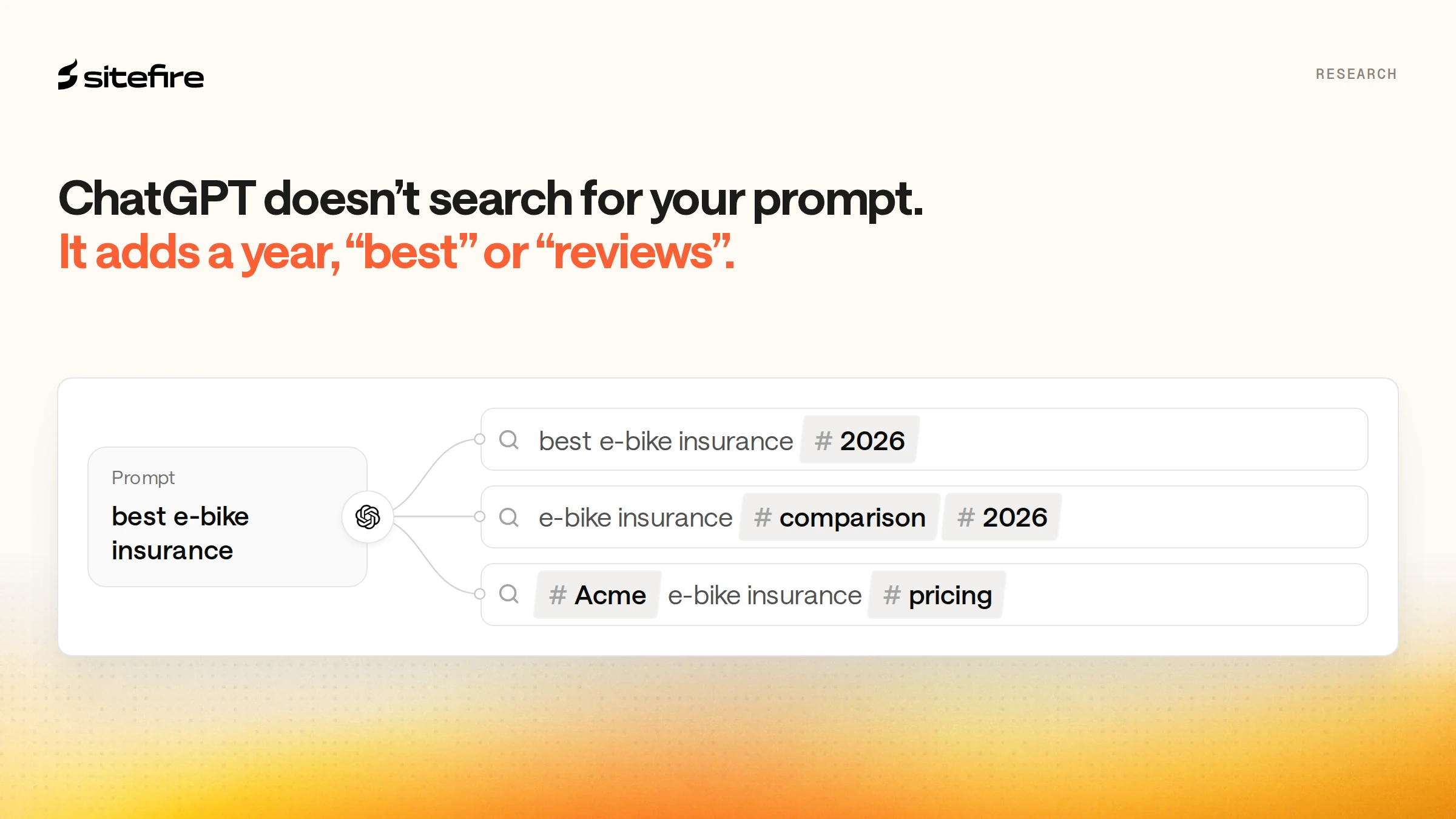
For commercial prompts, 77.3% of ChatGPT's answers ran a web search with a year in it. The prompts almost never contain one, so the AI model adds it: a prompt like "best [category]" goes out as a search like "best [category] 2026". For informational prompts the share is 39.5%.
We pulled 230,390 ChatGPT answers and their 419,892 query fan-outs (October 13 to November 17, 2026), sorted every prompt into one of four intents, and joined the same prompts to 3.47 million cited web pages from five AI models.
Result: ChatGPT rewrites the prompt before it searches, and what it adds depends on the intent of the prompt. The cited web pages follow the same split. So the search your page has to win is one the user never typed.
From four SEO intents to four GEO intents
SEO has sorted searches by intent for two decades. Andrei Broder's taxonomy of web search (2002) named three: informational, navigational and transactional. The SEO industry later split commercial investigation out as a fourth, and informational, navigational, commercial and transactional is the model every keyword tool still uses.
AI answers change two of the four. Navigational becomes brand/entity: people no longer ask an assistant to find a website, they ask what a company is and whether to trust it. Transactional becomes transactional/agentic: the assistant can carry out the task itself. Informational and commercial keep their names, though the prompts get longer and more specific.


Sitefire sorts every prompt into one of these four GEO intents. The full framework, with its 23 sub-intents and their sources, is in our Prompt Research methodology. This study covers the first three. Transactional/agentic prompts, where the assistant acts for the user, get their own study.
What does ChatGPT add to a search?
ChatGPT adds words the prompt did not contain, such as a year, "best", "reviews" or "official", and which ones it adds depends on the prompt's intent.
A query fan-out is a web search an AI model runs while it writes the answer (how query fan-outs work). It is not the prompt. ChatGPT rewrites the prompt into one or more searches and adds words of its own.
We read those searches as word discovery: word and phrase frequencies first, then eight patterns the frequent words fall into. A search carries every pattern it matches, so "best [category] comparison 2026" counts as comparison and as recency.
A search carries 2.0 patterns on average, and 67% of the 419,892 searches carry two or more. Reading each search as one type hides that.
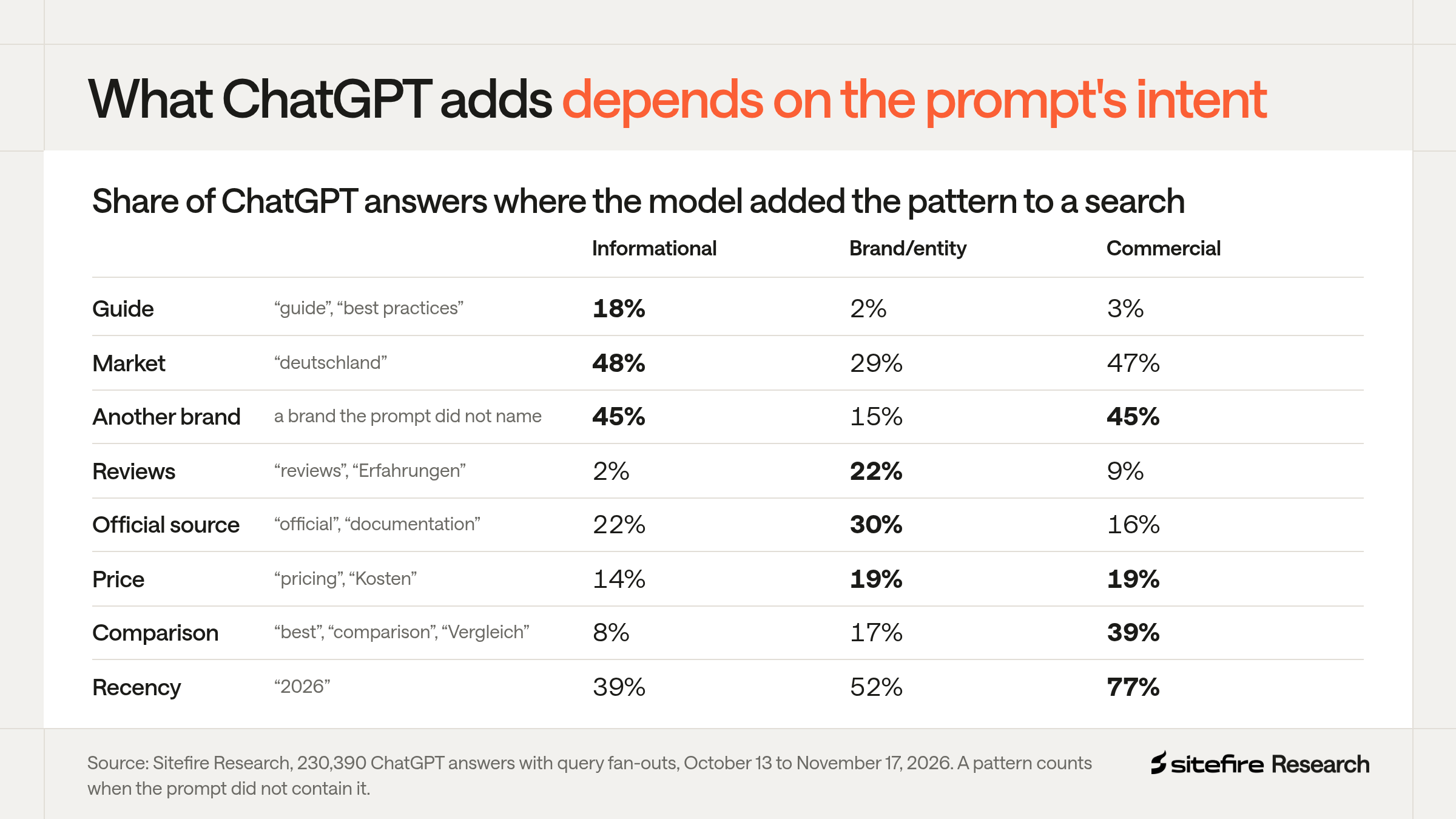
Each number is the share of answers in which ChatGPT added the pattern to at least one search and the prompt did not contain it. Bold marks the intent where the pattern is strongest.
Key observations:
- Each intent has its own signature. Commercial prompts get recency and comparison. Brand/entity prompts get reviews and the official source. Informational prompts get a guide.
- Price is added about equally everywhere, in 14 to 19% of answers.
- Another brand and the market are not intent patterns. They show up for informational and commercial prompts alike. More on both below.
Commercial prompts get a year and comparison words
ChatGPT adds a year to its searches in 77.3% of answers to commercial prompts. In English it is 84.9%.
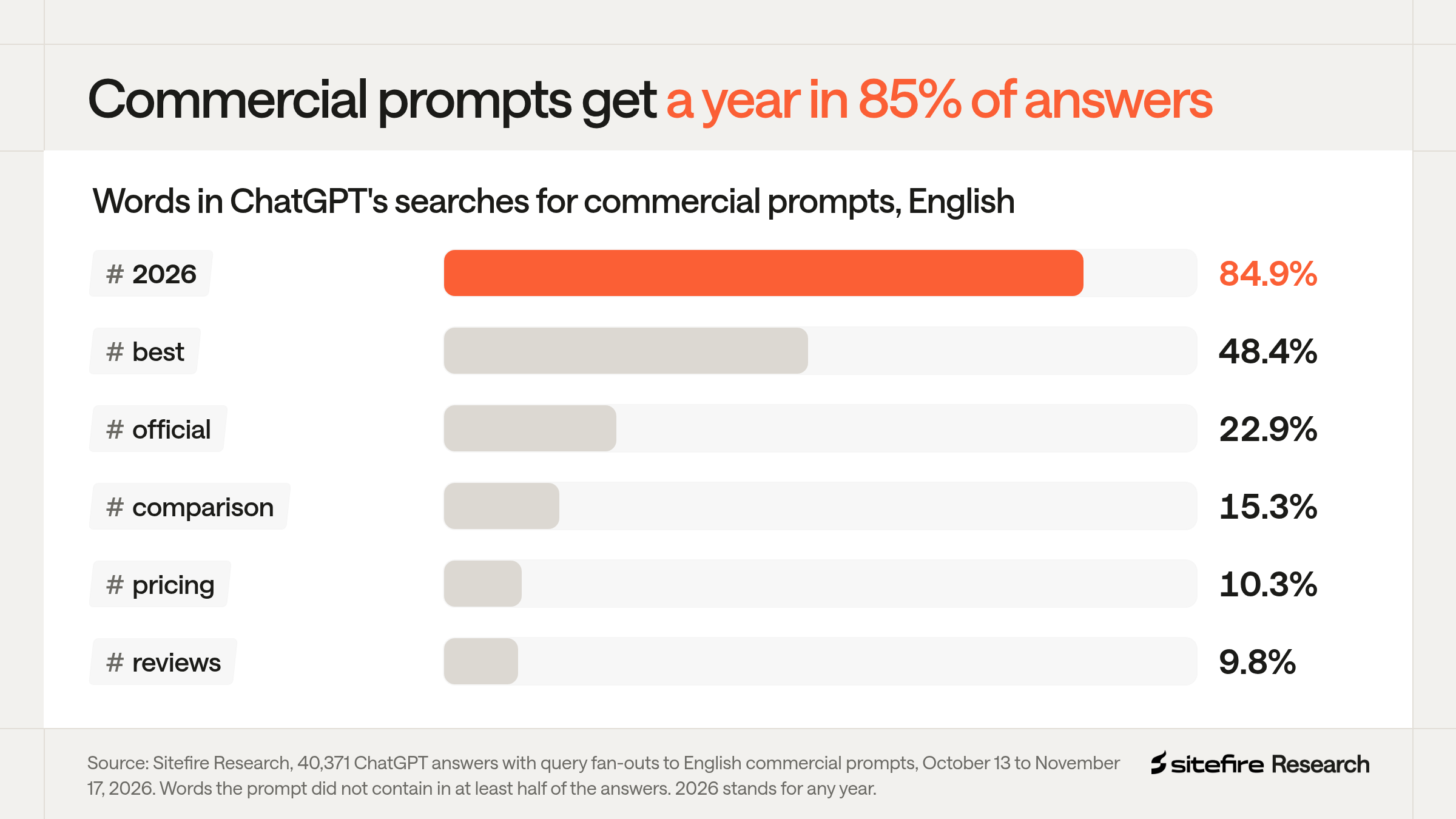
Comparison words travel with the year. ChatGPT adds one in 38.6% of commercial answers, against 8.1% for informational prompts. In English that is "best" and "comparison", in German "Vergleich" (25.2% of German commercial answers). "best" needs a caveat: about half the time the prompt already said it.
The most frequent added pair is comparison plus year: "best [category] 2026", "[category] comparison 2026", "[category] Vergleich 2026". A comparison page competes for a search that names a year in three answers out of four.
Brand prompts get the official site and reviews
When the brand is in the prompt, ChatGPT looks for two things: what the brand says about itself, and what others say about it.
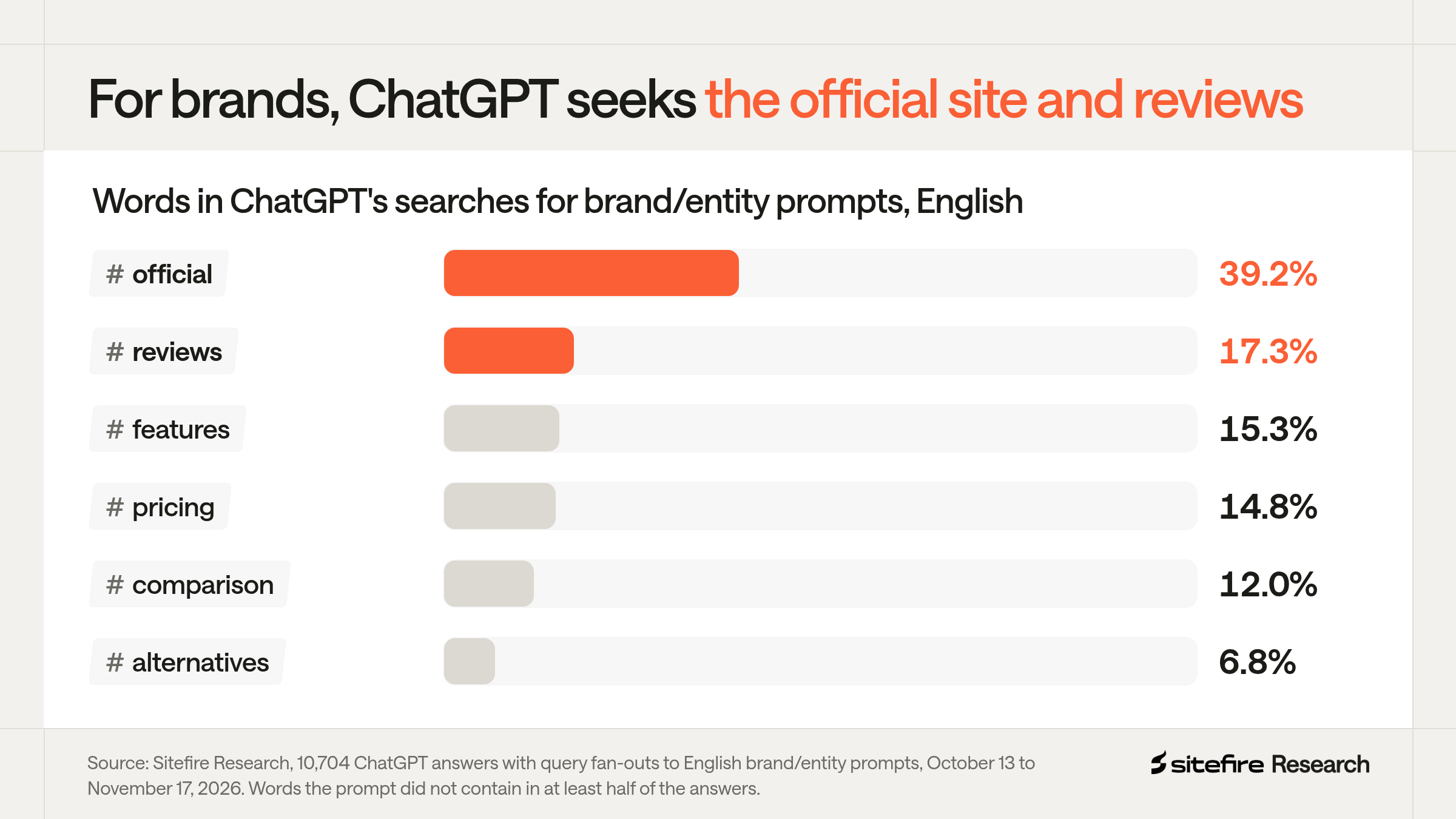
Review words are added in 21.9% of answers to brand prompts, against 2.1% for informational and 8.9% for commercial prompts. In German the words are "Erfahrungen" (22.6% of German brand answers) and "Bewertungen" (14.8%). A brand prompt often goes out as "[brand] official website" and "[brand] reviews".
The cited web pages match the searches:
| Cited web pages | Brand/entity prompts | Other intents |
|---|---|---|
| The brand's own site | 25.0% | 1.2 to 2.7% |
| User-generated content (UGC) | 13.5% | 6.2 to 7.0% |
The own-site share holds on all five AI models, from 19.8% to 28.9%. Part of it is built in, because a prompt with the brand in it produces searches with the brand in them. The size is what matters: a quarter of all cited web pages. The citation shares cover five AI models, while the searches we can see are ChatGPT's.
Informational prompts get the official source and a guide
For informational prompts, ChatGPT asks for the official source: "official", "documentation", "guidance".
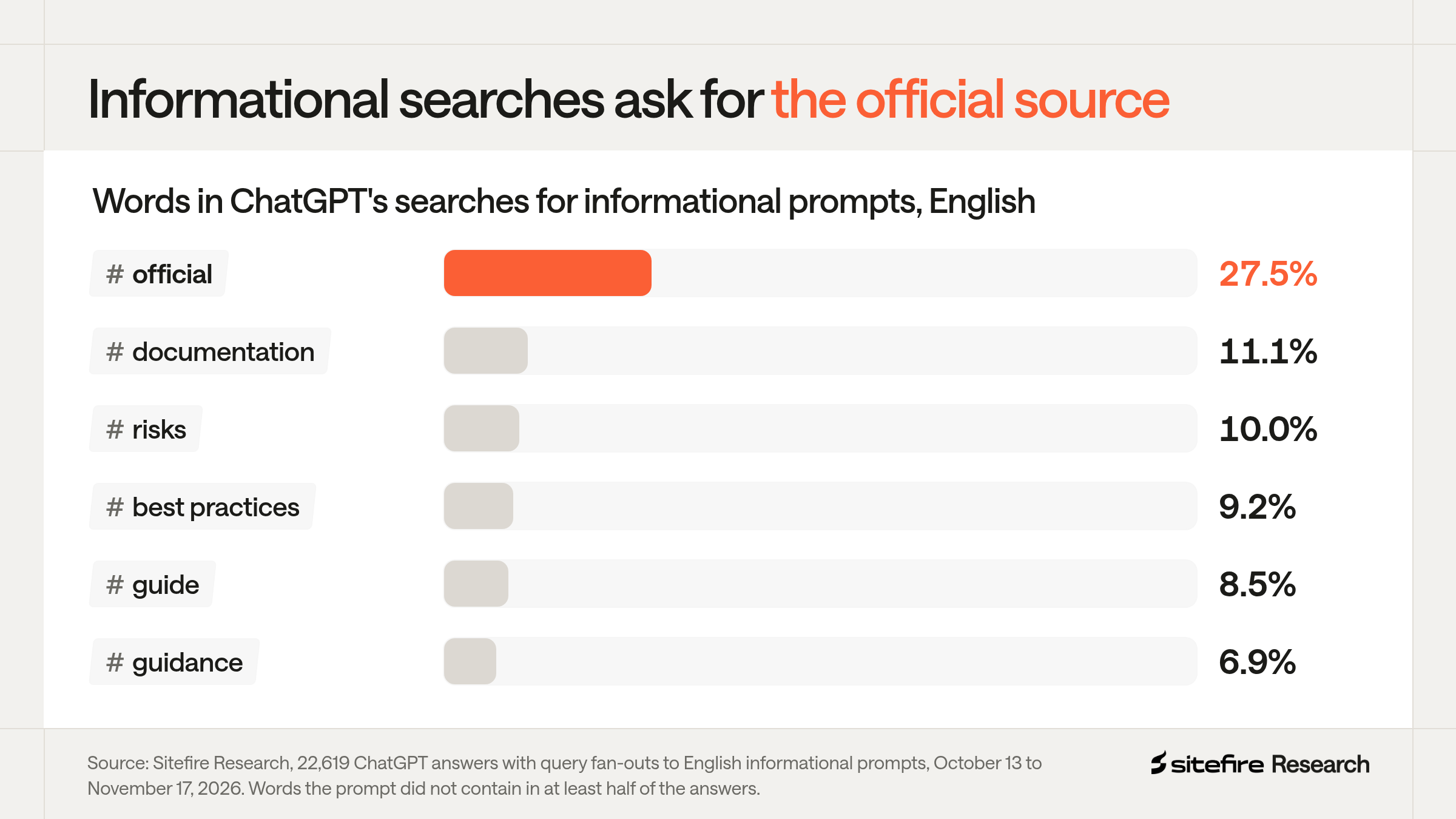
Guide words ("guide", "best practices", "definition") are added in 18.3% of informational answers, against 1.6% for brand and 3.1% for commercial prompts. "official" is not exclusive to this intent, ChatGPT adds it everywhere, but here it comes with "documentation" and "guidance" instead of "website".
The cited web pages match here too. For informational prompts, 23.6% of cited web pages are institutional (government, standards bodies, universities), against 6.6% for commercial prompts. The gap appears on every AI model, but the level is ChatGPT's: 42.9% there, 4.9 to 22.2% on the other four. That fits our earlier finding that AI models cite different sources.
On these prompts, a vendor page that explains how a product category works competes with public bodies for the citation, and the other vendors are the smaller threat.
ChatGPT names brands the prompt did not
In 44.8% of answers to commercial prompts, at least one of ChatGPT's searches names a brand that is not in the prompt. For informational prompts it is 44.9%.
The prompt asks for "the best [category]". The searches name candidates: "[brand] official", "comparison [brand]", "[brand] features". Somewhere between the prompt and the answer, ChatGPT picks brands and searches for them by name.
We count the brand names our customers track, a list that also holds sources such as comparison sites. Brands outside those lists are not counted.
German prompts get the market
ChatGPT adds a country name to its searches in 66.0% of answers to German commercial prompts. For English commercial prompts it is 7.6%. The gap appears for every intent: the market word follows the language of the prompt.
A typical German commercial search reads "[category] Vergleich Deutschland 2026": comparison, market and recency in one search.
What this means for the prompts you track and the pages you write
- Read your prompts by intent, never as one pool. A commercial and an informational prompt lead to different searches and to different kinds of cited web pages. An average over both describes neither.
- Track the search ChatGPT writes from the prompt. Your comparison page has to win "best [category] 2026", a search the user never typed. Keep the page current for the year the search names. Whether a year in the page title changes what gets cited, we did not test.
- Treat review platforms as part of your brand page. For brand prompts your own site already holds a quarter of the cited web pages. The next place ChatGPT looks is "[brand] reviews" or "[brand] Erfahrungen".
- Benchmark how-it-works content against official sources. On informational prompts the pages to beat belong to regulators, standards bodies and universities.
- Check which brands ChatGPT searches for by name. If the searches for your category name three competitors and not you, ChatGPT is not looking for your pages.
The Bottom Line
The prompt is what the user asks. The query fan-out is what your page competes for, and ChatGPT writes it differently for each intent: a year and a comparison for commercial prompts, the official site and reviews for brands, the official source and a guide for explanations. Start with the searches behind your most valuable commercial prompts and check whether they name your brand.
Sitefire records the query fan-outs behind every tracked ChatGPT answer and marks the words the model added. Prompt Research tags every prompt it proposes with one of the four GEO intents (how Prompt Research works).
How we measured this
Sample: every ChatGPT answer with recorded query fan-outs for the prompts Sitefire tracks for its customers, October 13 to November 17, 2026: 230,390 answers and 419,892 query fan-outs. Citations cover the same prompts on five AI models (ChatGPT, Gemini, Google AI Mode, Google AI Overviews, Perplexity): 3.47 million cited web pages.
Intent: a classifier assigned each prompt one of the four GEO intents from its text, and a prompt that contains the company's own brand name counts as brand/entity. The labels agree with a blind hand labeling in 84.5% of cases and with the product's own intent tags in 74.2%. Most disagreement sits between informational and commercial, which blurs the gaps between the two rather than creating them.
Words and patterns: each search is split into words, tracked brand names and years. A word counts as added by the model when the prompt does not contain it in at least half of the answers that use it, and a listed word appears for at least 20 prompts across at least 10 companies. The eight patterns are word lists we built by hand from the most frequent added words, in English and German. A pattern counts as added in an answer when the prompt does not contain the word.
Limits: the prompts are the ones Sitefire's customers track, with a large share of German-language prompts, so this is not a neutral sample of the web. The query fan-outs are ChatGPT's, the citations come from five AI models. German results describe German prompts, and we make no claim about other markets. The three intent results hold inside individual companies.
Frequently asked questions
Does ChatGPT add the year to its web searches?
For commercial prompts, yes, most of the time. 77.3% of ChatGPT answers to commercial prompts ran a query fan-out with a year in it, against 39.5% for informational prompts. The prompts themselves almost never contain a year.
What does ChatGPT search for when the brand is in the prompt?
The official site and reviews. In English, "official" is in the searches of 39.2% of answers to brand prompts and "reviews" in 17.3%. The citations match: 25.0% of cited web pages are on the brand's own site, against 1.2 to 2.7% for the other intents.
What does ChatGPT search for on informational prompts?
The official source and a guide. In English, "official" is in the searches of 27.5% of answers and "documentation" in 11.1%. Institutional sites (government, standards bodies, universities) are 23.6% of cited web pages for informational prompts, against 6.6% for commercial prompts.
Does ChatGPT search for brands the prompt did not mention?
Yes. In 45% of answers to commercial and to informational prompts, at least one of ChatGPT's searches names a brand that is not in the prompt.
Do other AI models add the same words to their searches?
We did not measure that. In this study ChatGPT is the AI model whose query fan-outs are observable, and the citation results cover five AI models.