How to Run a GEO Audit on Your Website
A 6-step framework to audit your AI search visibility across ChatGPT, Gemini, and more. Covers content structure, schema markup, and competitor benchmarking.

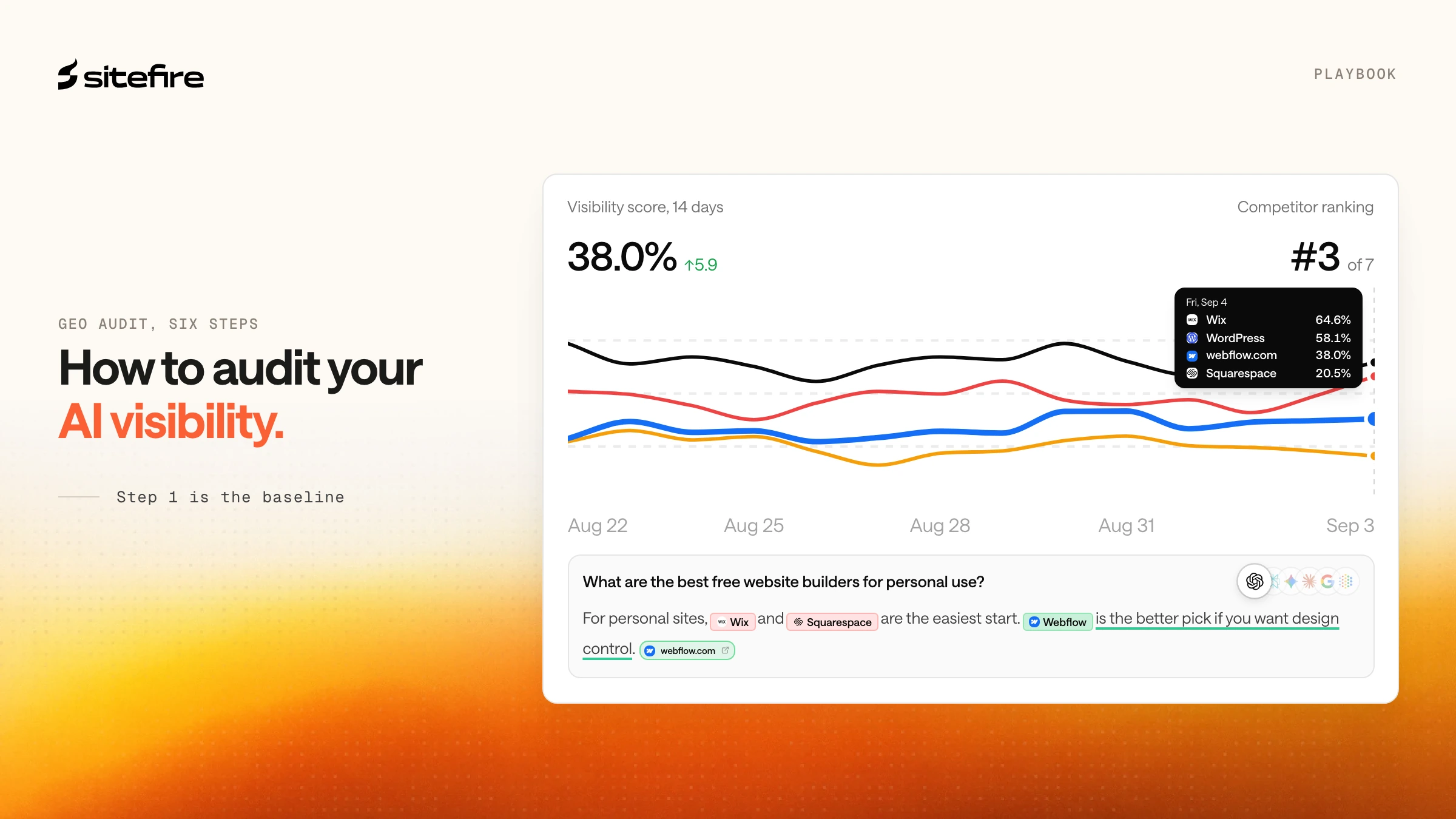
Most marketing teams know they should care about AI search visibility. Few have a structured way to assess it. This guide provides a 6-step GEO audit framework that any team can execute in 2-3 days.
AI Overviews now appear in 25.11% of Google searches, according to Conductor's analysis of 21.9 million queries. AI referral traffic is growing approximately 1% month-over-month across industries. Yet the gap between "we should do something about AI search" and "here is exactly what to fix" remains wide.
Existing guides are either gated behind vendor tools or too vague to act on. What follows is a vendor-neutral, data-backed methodology for evaluating how your brand appears across ChatGPT, Gemini, Perplexity, Claude, and Google AI Mode.
What Is a GEO Audit and Why Does It Matter?
A GEO audit is a systematic evaluation of how your brand appears, gets cited, and is described across AI-powered search platforms.
Traditional SEO audits measure rankings, crawlability, and click-through rates. GEO audits measure something different: whether AI models mention your brand, cite your content with links, and represent your product accurately in their responses.
| Dimension | SEO Audit | GEO Audit |
|---|---|---|
| What it measures | Rankings, crawlability, CTR | Citations, mentions, accuracy in AI answers |
| Target platforms | Google, Bing organic results | ChatGPT, Gemini, Perplexity, Claude, AI Mode |
| Key signals | Backlinks, keywords, domain authority | Content structure, source diversity, entity consistency |
| Success metric | Position in SERPs | Frequency and accuracy of AI mentions |
The distinction matters because the two types of visibility operate on different mechanisms. Research from Aggarwal et al., published at KDD 2024, found that GEO optimization strategies can boost visibility in AI responses by up to 40%. But the opportunity varies by platform. Citation rates range from 0.59% on ChatGPT to 27% on Grok, a 46x gap ( Superlines). A single-platform check misses the full picture.
At Sitefire, we treat GEO as complementary to SEO. AI search does not replace traditional search. It adds a new layer of discovery that requires its own audit methodology.
Step 1: Baseline Your Current AI Visibility
Start by querying 10-20 high-intent prompts across at least five AI platforms: ChatGPT, Gemini, Perplexity, Claude, and Google AI Mode.
Structure your prompts using four intent quadrants, a framework from Yext's 17.2 million citation analysis:
-
Branded objective: "What does [Your Company] do?"
-
Branded subjective: "Is [Your Company] good for [use case]?"
-
Unbranded objective: "Best tools for [category]"
-
Unbranded subjective: "What should I consider when choosing a [category] tool?"
For each prompt and platform, record the following:
| Prompt | Platform | Mentioned | Cited with Link | Accurate | Competitor Mentioned |
|---|---|---|---|---|---|
| "Best [category] tools" | ChatGPT | Y/N | Y/N | Y/N | [Names] |
| "Best [category] tools" | Gemini | Y/N | Y/N | Y/N | [Names] |
| "Best [category] tools" | Perplexity | Y/N | Y/N | Y/N | [Names] |
| "What does [Brand] do?" | ChatGPT | Y/N | Y/N | Y/N | [Names] |
Track mentions and citations separately. According to Superlines, 73% of AI presence consists of citations without brand mentions. Your brand's URL may appear in a source list without your name being mentioned in the answer text.
Different AI models draw from different source types. Some favor official websites while others rely on user-generated content and review sites 2-4x more heavily ( Yext). Testing across platforms is not optional.
Step 2: Audit Your Content Structure for AI Extractability
AI models extract information from web pages based on structure, not just topic relevance. Three factors determine whether your content gets cited.
Section length. Content sections of 120-180 words earn 70% more ChatGPT citations than sections under 50 words ( SE Ranking). Pull up your top 10 pages and check the average paragraph and section length. If your content runs in long, unbroken blocks, AI models struggle to extract clean, citable passages.
Content depth. Articles over 2,900 words are 59% more likely to be cited by ChatGPT than those under 800 words ( SE Ranking). This does not mean padding content with filler. It means comprehensive coverage of a topic signals authority to AI models.
Answer-ready formatting. Check each page for: clear H2/H3 heading hierarchy, summary boxes or key takeaways, numbered and bulleted lists, and comparison tables. These structural elements make content extractable. A page that answers a question but buries the answer in paragraph five of a long section will likely get skipped.
Schema Markup Check
According to BrightEdge research, sites with structured data and FAQ blocks see up to 44% more AI search citations. Pages with comprehensive schema markup are significantly more likely to appear in AI Overviews.
Audit your key pages against this checklist:
| Schema Type | Present | Valid | Priority |
|---|---|---|---|
| Article (author, datePublished, dateModified) | Y/N | Y/N | High |
| FAQPage | Y/N | Y/N | High |
| Organization | Y/N | Y/N | High |
| HowTo | Y/N | Y/N | Medium |
| Product (if applicable) | Y/N | Y/N | Medium |
| Review / AggregateRating | Y/N | Y/N | Low |
Validate your markup using Google's Rich Results Test. Invalid schema is worse than no schema: it signals low technical quality to crawlers.
Technical Accessibility
AI crawlers need access to your content. Check three things.
robots.txt directives. Verify that GPTBot, ClaudeBot, and Bingbot are not blocked. Some sites block AI crawlers by default or through overly restrictive rules.
Page speed. Pages with a First Contentful Paint under 0.4 seconds show 3x higher ChatGPT citation probability ( SE Ranking). Run PageSpeed Insights on your top 10 pages.
Server-side rendering. JavaScript-rendered content may not be accessible to AI bots. If your site is a single-page application, verify that critical content renders in the initial HTML response.
Step 3: Evaluate Your Content Freshness and Authority Signals
Freshness and authority are the two strongest content-level signals for AI citation selection.
Freshness. Content updated within the past three months is 2x more likely to be cited than older content ( SE Ranking). Pages updated within two months earn an average of 5.0 citations, compared to 3.9 for pages older than two years.
Pull up your top 20 pages and check the last-modified date. Any page older than three months that targets high-intent queries is a candidate for a refresh.
E-E-A-T signals. AI models evaluate credibility through visible authority markers. Audit each page for:
-
Author byline with name, role, and credentials
-
Link to author's LinkedIn or professional profile
-
Publication and last-updated dates displayed on the page
-
Methodology section (for data-driven content)
-
Cited sources with links to primary data
Citation readiness. Content that includes statistics, direct quotations, and cited sources achieves 30-40% higher visibility in AI responses ( Aggarwal et al.). Check whether your pages include first-party data, linked sources, and specific numbers. Vague claims ("many companies find that...") get skipped by AI models.
Score each page with a simple rubric:
| Signal | Score 0 | Score 1 | Score 2 | Score 3 |
|---|---|---|---|---|
| Freshness | >12 months | 6-12 months | 3-6 months | <3 months |
| Authority | No author | Author name only | Author + bio | Author + bio + credentials |
| Citation readiness | No sources | 1-2 sources | 3-5 sources | 5+ sources with data |
Pages scoring below 5 out of 9 should be prioritized for updates.
Step 4: Assess Your Third-Party Presence
AI models do not only cite your website. They cite third-party sites that mention you. This creates a second, often overlooked surface area for visibility.
Think of it as a citation funnel. At Sitefire, we use this framework to analyze how AI platforms build their answers: they retrieve pages from across the web (sourced pages), then select a subset to reference in their responses (cited pages). Some of those cited pages mention your brand (mentions). Third-party presence on trusted platforms expands the pool of pages that can pull your brand into AI responses at every stage of that funnel.
Audit your presence across these platform categories:
| Platform Type | Examples | Brand Present | Accurate | Priority |
|---|---|---|---|---|
| Review sites | G2, Capterra, TrustRadius | Y/N | Y/N | High |
| Discussion forums | Reddit, Quora | Y/N | Y/N | High |
| Video platforms | YouTube | Y/N | Y/N | Medium |
| Industry directories | Category-specific listings | Y/N | Y/N | Medium |
| Reference sites | Wikipedia, Crunchbase | Y/N | Y/N | Medium |
| News and media | Press coverage, guest articles | Y/N | Y/N | Low |
For each platform where your brand appears, verify accuracy. Outdated product descriptions, incorrect pricing, or old feature lists in third-party content can propagate through AI answers.
International considerations. US citation rates are 2.8x higher than non-US markets ( Superlines). If you serve customers outside the US, check whether your brand appears on region-specific review sites and directories.
Step 5: Benchmark Against Competitors
Run the same 10-20 prompts from Step 1 and record which competitors appear in each response. This reveals who owns AI visibility for your target queries.
Blog content is the #1 page type cited in AI Overviews, according to Conductor's benchmarks report analyzing 100 million citations. Compare your blog coverage against competitors for the topic areas that matter most to your buyers.
Build a competitor visibility matrix:
| Competitor | Mentioned (X/20) | Cited with Link (X/20) | Strongest Topic |
|---|---|---|---|
| Competitor A | |||
| Competitor B | |||
| Competitor C | |||
| Your Brand |
Identify content gaps. The most actionable output from competitor benchmarking is the list of queries where competitors appear and you don't. These gaps become your content priorities.
Cross-reference gaps with your existing content inventory. You may have a page that addresses the topic but lacks the structure, depth, or freshness to get cited. That is a restructuring problem, not a content creation problem.
Step 6: Prioritize Fixes and Build Your Action Plan
Organize your audit findings into three priority tiers based on impact and effort.
| Priority | Impact | Effort |
|---|---|---|
| Quick wins | High | Low |
| Medium-term fixes | High | Medium-High |
| Ongoing optimization | Compounding | Recurring |
Quick Wins
These changes require minimal effort and can improve AI visibility within one to two model update cycles.
-
Add missing schema markup. Article, FAQPage, and Organization schema take minutes to implement and directly affect citation probability.
-
Update stale content. Refresh publication dates and add recent data to your top-performing pages. A three-month refresh cadence doubles citation likelihood.
-
Fix crawler access. Review robots.txt for GPTBot and ClaudeBot blocks. Remove restrictions unless you have a specific reason to block AI crawlers.
-
Correct brand information. If AI models describe your product inaccurately, update the source pages they are likely pulling from: your website, review profiles, and directory listings.
Medium-Term Fixes
These require more effort but address structural gaps.
-
Restructure top pages for AI extractability. Break long sections into 120-180 word blocks. Add summary boxes, comparison tables, and key takeaway sections.
-
Create content for gap queries. Use the competitor benchmarking results from Step 5 to identify topics where you have no presence. Prioritize high-intent queries where multiple competitors appear.
-
Build third-party presence. Claim and update profiles on review platforms. Contribute to relevant Reddit threads and industry discussions with genuinely useful information.
Ongoing Optimization
This is where a one-time audit hits its limits. A snapshot tells you where you stand today, but AI citation patterns are not static. Models retrain on new data. Competitors publish new content. A page that ranks in AI answers this month may disappear next month because a competitor published something more comprehensive or fresher.
Content updated within three months is 2x more likely to be cited ( SE Ranking). That means the audit findings you generate today start losing accuracy within weeks. Manual re-auditing (querying 20 prompts across 5 platforms, recording results, comparing to last month) takes hours each cycle. Most teams do it once, learn something useful, and then never repeat it.
This is why continuous monitoring matters more than any single audit. The audit gives you a starting point. Ongoing tracking tells you whether your fixes are working, whether competitors are gaining ground, and where the next content gap is opening.
-
Re-run your top prompts regularly across all platforms.
-
Track citation trends over time. Are you gaining or losing mentions?
-
Monitor competitor movements: new content, new third-party mentions.
Sitefire automates this ongoing monitoring across all major AI models and 180+ markets, surfacing action recommendations so your team can focus on execution rather than manual tracking.
GEO Audit Checklist
Use this consolidated checklist to track your audit progress across all six steps.
| Audit Area | Check | Priority |
|---|---|---|
| Visibility Baseline | Test 10-20 prompts across 5+ AI platforms | High |
| Record mentions, citations, and accuracy per prompt | High | |
| Document competitor appearances per prompt | High | |
| Content Structure | Section length: 120-180 words per section | High |
| Content depth: 2,000+ words for key pages | Medium | |
| H2/H3 hierarchy with scannable headings | High | |
| Summary boxes and key takeaways present | Medium | |
| Comparison tables where applicable | Medium | |
| Schema Markup | Article schema with author and dates | High |
| FAQPage schema on relevant content | High | |
| Organization schema | High | |
| All schema validated via Rich Results Test | High | |
| Technical Access | GPTBot, ClaudeBot not blocked in robots.txt | High |
| FCP under 0.4 seconds on top pages | Medium | |
| Critical content server-side rendered | Medium | |
| Freshness and Authority | Top pages updated within 3 months | High |
| Author bylines with credentials | Medium | |
| Sources cited with links to primary data | Medium | |
| Third-Party Presence | Review site profiles complete and accurate | High |
| Reddit and forum presence for key topics | Medium | |
| Industry directory listings current | Medium | |
| Competitor Benchmark | Competitor visibility matrix completed | High |
| Content gaps identified and documented | High | |
| Gap content creation plan prioritized | Medium |
Frequently Asked Questions
How long does a GEO audit take?
A manual GEO audit using this six-step framework takes 2-3 days for a mid-sized website with 50-200 pages. The visibility baseline (Step 1) and competitor benchmarking (Step 5) are the most time-intensive steps because they require querying multiple platforms manually. Automated monitoring tools can reduce the baseline assessment to hours, but the content structure and third-party audits still require manual review.
How often should I run a GEO audit?
Run monthly spot-checks on your top 10 prompts across all platforms. Conduct a full audit quarterly. AI models update their training data and retrieval pipelines frequently, and citation patterns shift as competitors publish new content ( Yext). A page that gets cited today may not get cited next month if a competitor publishes something more comprehensive.
Does GEO replace SEO?
No. GEO complements SEO. AI Overviews appear in 25.11% of Google searches ( Conductor), which means traditional organic results still drive the majority of discovery. The goal is visibility in both channels. Many GEO improvements (better content structure, schema markup, fresh content) also benefit SEO rankings.
What tools do I need for a GEO audit?
At minimum: access to five or more AI platforms (free tiers work), Google's Rich Results Test for schema validation, PageSpeed Insights for performance checks, and a spreadsheet for tracking results. If you want to skip the manual baseline, Sitefire provides a free AI visibility snapshot (20 prompts across models) with actionable recommendations when you create an account. For ongoing monitoring, a 7-day trial lets you see what continuous tracking looks like before committing.
Which AI platforms should I prioritize?
Start with ChatGPT (largest user base), Google AI Mode and AI Overviews (integrated into existing search behavior), and Perplexity (high citation rates and growing user base). Citation rates vary 46x across platforms ( Superlines), so limiting your audit to one or two platforms leaves significant blind spots. Test at least five platforms for a reliable baseline.
Key Takeaways
-
A GEO audit is the structured process of evaluating how your brand appears across AI search platforms, covering visibility, content structure, authority signals, third-party presence, and competitor positioning.
-
AI citation patterns vary dramatically by platform, content structure, and industry. Testing across at least five platforms is essential for a reliable baseline.
-
Content sections of 120-180 words earn 70% more citations. Articles over 2,900 words are 59% more likely to be cited. Structure matters as much as substance.
-
Schema markup (Article, FAQ, Organization) with valid implementation increases AI citations by up to 44%. This is one of the highest-impact, lowest-effort fixes available.
-
Content freshness is a strong citation signal. Pages updated within three months are 2x more likely to be cited than older content.
-
Third-party presence on review sites, forums, and directories expands your citable surface area beyond your own website.
-
Make GEO auditing a recurring process. Monthly spot-checks and quarterly full audits keep you ahead of shifting citation patterns.
AI referral traffic is growing approximately 1% month-over-month ( Conductor). The shift is steady, not sudden. But the companies that build systematic audit practices now accumulate a compounding advantage over those that wait.
Start with the six steps in this guide. If you want to see where you stand right now, create a free Sitefire account to get an AI visibility snapshot: 20 prompts across all major models, with actionable recommendations on what to fix first. From there, a 7-day trial shows you what continuous monitoring looks like, so you can decide whether to keep auditing manually or let the data come to you.
Sources
-
Aggarwal et al. "GEO: Generative Engine Optimization." KDD 2024.
-
BrightEdge. "Structured Data in the AI Search Era." 2025.
-
Conductor. "The 2026 AEO/GEO Benchmarks Report." Analysis of 21.9M queries and 13,770 domains.
-
Google Search Central. "Introduction to Structured Data."
-
SE Ranking. "70+ AI Search Stats for 2026." Analysis of 129K domains.
-
Superlines. "AI Search Statistics 2026." 60+ data points on visibility, citations, and traffic.
-
Yext. "AI Citation Behavior Across Models." Analysis of 17.2M citations, Q4 2025.